

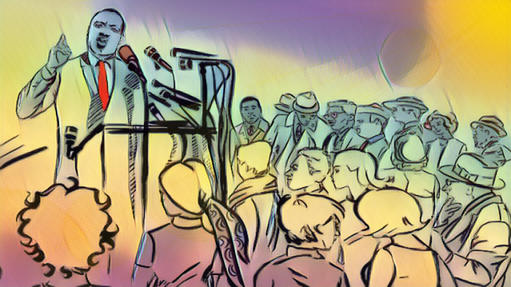
“I have a dream that my children will one day
live in a nation where they will not be judged
by the color of their skin but by their character.”
But as long as bigotry exists in the hearts of the affluent;
as long as racism is in the eyes of white supremacists;
as long as police unions operate above the law;
as long as Republicans are allowed to rule over us,
it’s just a dream—nothing more, nothing less.
The American dream is not for everyone;
it’s just for the elite,
so do us all a favor and get over it!
By: ElRoyPoet © 2021
Let’s talk about conservatives admitting systemic racism exists
Commentary: MLK’s “I have a Dream” speech was inspired, no doubt about it! However, advocates for BLM have given up on his dream, because they perceive that no real progress has been made since the civil and voting rights laws of 1964 and 1965 were enacted. And to make matters worst, patriots are now claiming that CRT is a movement that will divide their country, when everybody knows that it was really trump who instigated all this divisive rhetoric. Now the christian nationalists are following suit, because they’re afraid it will also destroy their religion, even though the law plainly reads that church and state are to be separate. It seems to me, that we wouldn’t be having this controversy in the USA, if the contemptible republicans wouldn’t still be trying to cancel these enshrined acts—that 3 great American democrats (MLK, JFK and RFK) were martyred for.
Why intolerance leads to polarization and then to the end of civility. Since we’re all social creatures, we take cues from our surroundings. Our brains become frustrated when those around us aren’t friendly to our cause. Consequently, we become agitated when we encounter opposition. Since the beginning of time, these defense mechanisms have been hard wired into our bodies for our self-preservation—if we’re confronted, we either fight or take flight. However, we can‘t run away from every hostile environment. Sooner or later our brains will have to learn more efficient ways to stand up for our beliefs. Besides, even if fleeing from trouble works most of the time, we will eventually become fatigued and what are we going to do when we’re backed up into a corner?
Political warfare dictates, that the oppressed man’s chances of survival are better if he takes the first strike. And eventually he decides, that in order to overcome, it’s better to pursue his enemies before they become too powerful. So he resorts to covert tactics, such as profiling and discrimination. It’s not that he doesn’t aspire to be a good neighbor. It’s just that if he picks up any unfriendly cues, his brain defaults to hate, out of fear that he will lose something that’s precious to him. If he perceives a threat approaching, he transitions into patriotic mode and starts plotting on how to protect the homeland—before he is conquered.
“Now let us be sure that we will have to keep the pressure alive. We’ve never made any gain in civil rights without constant, persistent, legal and non-violent pressure. Don’t let anybody make you feel that the problem will work itself out… For those who are telling me to keep my mouth shut, I can’t do that… I’m not going to segregate my moral concerns. And we must know on some positions, cowardice asks the question, “Is it safe?” Expediency asks the question, “Is it politic?” Vanity asks the question, “Is it popular?” But conscience asks the question, “Is it right?” And there are times when you must take a stand that is neither safe nor politic nor popular, but you must do it because it is right.”
Quotes by: Martin Luther King Jr. was a Baptist minister and a leader of the American civil-rights movement. He was awarded the Nobel Peace Prize in 1964 for employing non-violent civil disobedience to advance racial equality.
“To be in denial only benefits the oppressor […] Blacks must remove the shackles of mental enslavement themselves; otherwise, mental liberation will NEVER become a reality. Slavery is never abolished it is transformed, only the slave can destroy slavery. You cannot destroy slavery by becoming a part of your slave master’s culture incubator.” Excerpt from Black America Has Been Programmed to be its Own Worst Enemy. (In other words, if you assimilate, you are grafted into your new master’s culture, but if you resist, you’re obliged to return to your previous sovereign state where you must dominate to make the rules!)
“It would twist the minds of men, as greed and self-reverence eclipsed human conscience and allowed the conquering men to take land and human bodies that they convinced themselves they had a right to. If they were to convert this wilderness and civilize it to their liking, they decided, they would need to conquer, enslave or remove the people already on it, and transport those they deemed lesser beings in order to tame and work the land to extract the wealth that lay in the rich soil and shorelines.
To justify their plans, they took pre-existing notions of their own centrality, reinforced by their self-interested interpretation of the Bible, and created a hierarchy of who could do what, who could own what, who was on top and who was on the bottom and who was in between. There emerged a ladder of humanity, global in nature, as the upper-rung people would descend from Europe, with rungs inside that designation – the English Protestants at the very top, as their guns and resources would ultimately prevail in the bloody fight for North America. Everyone else would rank in descending order, on the basis of their proximity to those deemed most superior. The ranking would continue downward until one arrived at the very bottom: African captives transported in order to build the New World and to serve the victors for all their days, one generation after the next, for 12 generations.
There developed a caste system, based upon what people looked like—an internalized ranking, unspoken, unnamed and unacknowledged by everyday citizens even as they go about their lives adhering to it and acting upon it subconsciously, to this day. Just as the studs and joists and beams that form the infrastructure of a building are not visible to those who live in it, so it is with caste. Its very invisibility is what gives it power and longevity. And though it may move in and out of consciousness, though it may flare and reassert itself in times of upheaval and recede in times of relative calm, it is an ever-present through-line in the country’s operation.” Excerpt from America’s ‘untouchables’: the silent power of the caste system
“Injustice anywhere is a threat to justice everywhere. We are caught in an inescapable network of mutuality, tied in a single garment of destiny. Whatever affects one directly, affects all indirectly.” By: Martin Luther King
“Anger and intolerance are the twin enemies of correct understanding.” By: Mahatma Gandhi
“Patriotism is when love of your own people comes first; nationalism, when hate for people other than your own comes first.” By: Charles de Gaulle
“The world has enough for everyone’s need, but not enough for everyone’s greed.” By: Mahatma Gandhi
“Ignorance breeds fear. We fear those things we don’t understand. If we don’t put a lid on that fear and keep that fear in check, that fear in turn will breed hatred because we hate those things that frighten us. “If we don’t keep that hatred in check, that hatred in turn will breed destruction.” By: Daryl Davis
Martin Luther King Jr.: “My dream has turned into a nightmare”
The Poem’s Central Theme: A Dream for Equality
The opening lines of the poem reference a well-known quote from Dr. Martin Luther King Jr.’s “I Have a Dream” speech delivered during the 1963 March on Washington for Jobs and Freedom. This speech highlighted the ongoing struggle for civil rights and the vision of a future where children would be judged by their character rather than the color of their skin. The speaker in this poem invokes this dream, signifying a continuity of the civil rights movement while also illustrating how far society still has to go. The mention of “my children” represents hope but also an acknowledgment of the persistent racial divides that continued beyond the 1960s.
Confronting Bigotry and Systemic Racism
The poem takes a stark turn as it addresses the factors that undermine this dream. The lines highlight the deep-rooted nature of bigotry, suggesting that it is not merely an individual fault but ingrained within the societal fabric, particularly in the hearts of those with power: “as long as bigotry exists in the hearts of the affluent.” This line serves to critique how the wealthy and powerful can perpetuate systemic racism that maintains their social status at the expense of marginalized communities.
Historically, this echoes the sentiments expressed during the post-Civil Rights era, particularly with the emergence of systemic inequalities that lingered despite legislative progress, such as the Civil Rights Act of 1964 and the Voting Rights Act of 1965. These laws aimed to dismantle segregation and protect voting rights, yet many of the intended changes were obstructed or undermined by societal attitudes and institutional practices.
The critique extends to the legal system with the mention of “police unions operate above the law,” pointing to the rise of police brutality incidents and the struggle for police accountability, particularly among communities of color. The significance of this phrase cannot be understated; it reflects ongoing tensions highlighted by movements such as Black Lives Matter, founded in 2013 in response to the systemic racism evident in police violence against Black individuals and other people of color.
The American Dream: An Elite Ideal
In the concluding stanzas, the poem directly confronts the notion of the American Dream, deeming it “not for everyone; it’s just for the elite.” This line encapsulates the disillusionment felt by many regarding the American Dream, proposing that it has increasingly become an unattainable ideal for marginalized communities. The idea that the dream is an exclusive privilege for a select few rather than a universal opportunity speaks to the socioeconomic disparities that the United States has grappled with since its founding.
Historically, the American Dream has been framed as a promise of freedom, equality, and the pursuit of happiness for all, yet this has often been undermined by economic disparities, racial discrimination, and systemic barriers. The Great Migration of the early 20th century, in which millions of African Americans moved from the rural South to urban areas in the North and West, further highlighted the gap between the ideal and the reality of American life. While seeking better opportunities, many found themselves faced with discrimination and limited access to resources.
The closing lines, “so do us all a favor and get over it!” add an urgent tone, compelling the reader to acknowledge these disparities rather than dismiss them. This challenging sentiment reflects a growing frustration with euphemistic discussions around race and class in America, urging a confrontation with uncomfortable truths rather than shallow reassurances.
 elroypoet.blog
You are absolutely correct in everything you have said here. The sad part is that no matter how many discussions are held, no matter how many laws are passed, nothing is ever going to change. Appearances may change but reality will never change. America was built on bigotry, America is run on bigotry and America will always be bigoted and prejudicial in one form or another … either outwardly in the light or hidden in dark places. People who have been led to believe that progress has been made in these areas are deceiving themselves. One of the most horrible stories I ever heard about Emancipation was the story that when American Black People were supposedly freed back in the late 1800s, they discovered that they had to work as share croppers and give a large portion of what they grew to the property owners. This in itself was a form of slavery and people who got caught in it weren’t free at all. All the Jim Crow stuff is still alive and well in America .. it has just changed form in most instances.
LikeLike