
Middle class beware,
The union is out to get you.
There can’t be
A bourgeois society
If the elites don’t need you.
In an authoritarian state,
It’s too hard to differentiate,
Between all the nationalist drones.
You’re either in the in-group,
And since you’re not, you’re out.
Religion can’t save you,
And academics aren’t allowed,
Because syndicates hate media.
Democracy is just too difficult,
Fascism is so much easier.
By: ElRoyPoet © 2020
Analogy: If your neighbor Jake brings his pet rattle snake to your house and turns it loose. You don’t sit down with Jake and debate whether or not the snake is poisonous, you don’t discuss politics and ignore it, and hope it doesn’t bite anybody in your family. You must shut down all communications with Jake and immediately find a way to cage the snake, so that you can take it out of your house and eradicate it, because you know that it is a deadly threat to your family. That’s how you must respond to the propaganda and incendiary rhetoric coming from a fascist (white supremacist, Nazi sympathizer, nationalist bigot). You can’t reform a snake, because it will always come back to bite you!
The Path Toward Authoritarianism in the United States: A Case Study of Trump, the MAGA Movement, the Republican Party, and Evangelical Influence
The rise of Donald Trump, the MAGA (Make America Great Again) movement, the Republican Party, and influential evangelical groups illustrates how societal fears, nationalist fervor, and psychological manipulation can potentially pave the way toward authoritarianism. Under the guise of protecting national identity, security, and moral values, these forces have employed strategies reminiscent of historical Italian and Nazi fascist movements in—exploiting vulnerabilities within American society to consolidate power and undermine democratic norms.
Historical Context and Psychological Drivers:
In recent years, the United States has experienced increasing polarization, economic uncertainty, and cultural upheaval. Economic disparities, social unrest, and a sense of cultural loss have fostered anxieties among segments of the population. Many Americans feel alienated or threatened by demographic shifts, globalization, and changing social norms. These fears are exploited by Trump and MAGA leaders, which promises to restore what they portray as the lost greatness of America—tapping into a masculinity and identity crisis similar to those seen in past fascist regimes. The desire for a strong, decisive leader who can “save” America appeals to a deep psychological yearning for stability, dominance, and cultural supremacy.
Fear of Internal and External Threats:
A central tactic has been to amplify fears of internal enemies—such as political opponents, immigrants, Muslims, or “elites”—and external threats like China or other foreign powers. The MAGA movement, under Trump’s leadership, has relentlessly framed these groups as existential threats to American values and sovereignty. This narrative of “saving America” from these enemies fosters scapegoating and unites supporters around a nationalist, exclusionary, and often xenophobic agenda. The demonization of critics and marginalized groups serves to consolidate loyalty and justify extraordinary measures, including attempts to undermine electoral integrity and civil liberties.
Psychological Manipulation and Propaganda:
Leaders and factions associated with the MAGA movement have employed sophisticated propaganda techniques to manipulate public perceptions. The widespread use of social media to spread disinformation, conspiracy theories (such as QAnon), and attacks on democratic institutions has been central. Rhetoric emphasizing law and order, patriotism, and a “corrupt” political establishment fuels us-versus-them thinking. The repeated portrayal of political opponents as enemies of the nation, along with the glorification of a charismatic leader—Donald Trump—encourages followers to accept or overlook violations of democratic norms. The narrative includes myth-making about restoring America’s lost greatness and defending traditional values against “the radical left” and “globalist elites.”
The Role of Violence and Intimidation:
Some extremist groups and individuals associated with the MAGA movement have engaged in violence, intimidation, and acts of political vandalism. The attack on the U.S. Capitol on January 6, 2021, exemplifies how rhetoric incited by influential figures can escalate into violent action aimed at overturning democratic processes. Psychological studies suggest that under authoritarian or fascist regimes, ordinary individuals can be mobilized to support or participate in violence when driven by propaganda, groupthink, and perceived loyalty to a charismatic leader. When violence is tolerated or encouraged as a means of defending national purity or sovereignty, it fosters an environment where dissent becomes dangerous and authoritarian control more easily consolidates.
From Democratic Norms to Authoritarian Control:
Within this environment, efforts to weaken democratic institutions—such as attacking the independence of the judiciary, undermining free press, spreading false claims of electoral fraud, and consolidating power within a partisan framework—are justified by leaders as necessary for national security and restoring order. The rhetoric often portrays democracy itself as corrupt or partisan, positioning authoritarian measures as the only way to restore strength and greatness. This erosion of democratic norms, coupled with the mobilization of loyalist groups, can lead to the gradual dismantling of civil liberties, checks and balances, and the rule of law—hallmarks of fascist regimes.
In summary, the rise of Trump, the MAGA movement, the Republican Party, and evangelical leaders demonstrates how fear, nationalism, propaganda, and violence can be exploited to threaten and undermine democratic principles. By fostering a climate of division, scapegoating minorities, and glorifying authoritarian leadership, these forces are laying the groundwork for a potential shift toward fascism. Recognizing these patterns is essential for safeguarding democracy, promoting civic resilience, and preventing history’s darkest chapters from repeating themselves. Vigilance, critical engagement, and a steadfast commitment to democratic norms are vital to ensuring that such developments do not lead to the establishment of an authoritarian or fascist state in the United States.
What Happened to Germans After WWII
The Rise of Nazism in Germany: A Case Study of Fear, Nationalism, and Psychological Manipulation
Germany’s ascent to Nazi dictatorship under Adolf Hitler exemplifies how societal fears, deep-seated nationalism, and psychological manipulation can facilitate the emergence of totalitarian regimes. In the aftermath of World War I, Germany was engulfed in economic hardship, national humiliation, and social unrest—all of which created a fertile environment for extremist ideologies to flourish.
Historical Context and Psychological Drivers:
Following Germany’s defeat in World War I, the nation experienced profound humiliation through the Treaty of Versailles, which imposed severe territorial losses, military restrictions, and reparations. The German people faced hyperinflation, unemployment, and economic instability, leading to widespread disillusionment. Psychologically, this fostered a sense of betrayal—embodied in the term “Diktat”—and a desperate desire to restore national pride. The social psychology of collective trauma and identity crisis fueled a yearning for a strong leader who could revive Germany’s former glory, aligning with theories of masculinity crisis and collective nostalgia.
Fear of Communism and External Threats:
The revolutionary upheavals in Russia and the rise of communism in Eastern Europe heightened fears among the German middle and upper classes. Many perceived the Soviet Union’s success as a threat to traditional social hierarchies and private property. This fear of revolutionary upheaval was exploited by the Nazi Party, which positioned itself as the defender of conservative order and nationalism. Propaganda painted Jews, communists, and socialists as existential enemies—scapegoats responsible for Germany’s woes—thus uniting wide segments of the population against perceived internal and external threats.
Psychological Manipulation and Propaganda:
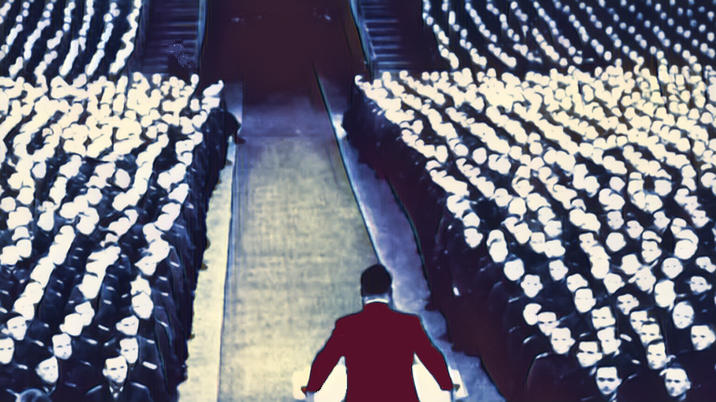
Hitler and the Nazi Party mastered the art of propaganda to manipulate mass psychology. They employed hyper-nationalism, racial ideology, and myth-making to foster a collective identity rooted in racial superiority and destiny. Through rallies, symbols like the swastika, and slogans such as “Ein Volk, ein Reich, ein Führer,” they created a sense of unity and purpose. The Nazis emphasized the idea of a renewed German empire (Lebensraum) and used scapegoating to channel societal anxieties. The regime’s propaganda machines, led by Joseph Goebbels, crafted messages that tapped into fears of chaos, racial impurity, and national decline, thereby fostering a climate of us-versus-them thinking. Mass rallies and propaganda films created a sense of belonging and purpose, often temporarily suppressing individual doubts and dissent.
The Role of Violence and Intimidation:
The Nazi paramilitary organizations, such as the Sturmabteilung (SA) and later the Schutzstaffel (SS), used violence, intimidation, and terror tactics to suppress opposition. The Night of the Long Knives and the suppression of political opponents demonstrated how violence was employed to consolidate power. Psychological studies, like those by Stanley Milgram, highlight how ordinary individuals can commit or support atrocities under authoritative pressure. The pervasive atmosphere of fear, combined with promises of order and national revival, led many Germans to accept or overlook violence as a necessary step towards their perceived salvation.
From Democratic Fragility to Totalitarian Rule:
Germany’s democratic Weimar Republic was fragile and faced immense economic and social challenges. The Nazi rise culminated in Hitler’s appointment as Chancellor in 1933, followed by the swift dismantling of democratic institutions, suppression of civil liberties, and the establishment of a totalitarian dictatorship. The German populace, driven by fears of communism, economic collapse, and national humiliation, largely acquiesced—sometimes out of genuine belief, sometimes out of resignation or fear. Once in power, the Nazi regime systematically marginalized Jews, political opponents, and other minorities, illustrating how societal fears and psychological manipulation can be exploited to justify authoritarian rule.
In summary, Germany’s Nazi ascent demonstrates how fear—of communism, economic instability, and national decline—combined with intense nationalism, racial ideology, propaganda, and violence, can lead societies down a dangerous path toward authoritarianism. Recognizing these patterns underscores the importance of safeguarding democratic institutions, promoting critical thinking, and fostering social resilience to prevent similar trajectories in the future.
Commentary: Fascists are opposed to whomever they deem as degenerates (refugees, minorities, addicts, convicts and whomever else, their leader frames as unpatriotic). Fascists do not only seek to hate them, but to dominate them. If fascists believe an out-group serves a purpose, it is permitted but controlled. If fascist believe the out-group serves no purpose, they will try to remove it from the community. Fascist hierarchies reject egalitarianism so completely, that co-existence is impossible. Fascism is not an intellectual ideology but a white supremacist movement based on the dogma of fear, insecurity and misplaced anger. The form of government fascists want the public to assimilate is ultra-nationalism—which is antithetical to a representative democracy. Therefore fascism is illegitimate and should not be tolerated in a pluralistic society, because it is an existential threat to the citizens of America.
“Conservatism consists of exactly one proposition, to wit: There must be in-groups whom the law protects but does not bind, alongside out-groups whom the law binds but does not protect.
The law cannot protect anyone unless it binds everyone; and it cannot bind anyone unless it protects everyone.”
Excerpt from Conservatism and Who the Law Protects
Definition: Egalitarianism is the doctrine that all people are equal and deserve equal rights and opportunities. Political egalitarianism posits that each individual has the same social power or influence over politics in work, government and daily life.
“Pundits like to take refuge in the saccharine refrain, “this is not who we are,” but historically, this is exactly who we are. Political violence is an endemic feature of American political history. It was foundational to the overthrow of Reconstruction in the 1870s and the maintenance of Jim Crow for decades after.” Excerpt from Where Will This Political Violence Lead? Look to the 1850s.
“Being good is hard if you live under an authoritarian regime… Dictatorships elevate the nation and the leader as ultimate ends, while mere individuals have no inherent worth outside of their service to the state… Damir Marusic, an Atlantic Council senior fellow, recently wrote, ‘Putin is a wholly authentic Russian phenomenon, and the imperialist policy he’s pursuing in Ukraine is too.’ This is right, but only up to a point. We simply don’t know what individual Russians would choose, want—or become—if they had been socialized in a free, open democracy, rather than a dictatorship where fear is the air one breathes. Like everyone else, they are products of their environment. Authoritarianism corrupts society. Because punishment and reward are made into arbitrary instruments of the state, citizens have little incentive to pool resources, cooperate, or trust others. Survival is paramount, and survival requires putting one’s own interests above everything else, including traditional morality. In such a context, as the historian Timothy Snyder puts it, ‘life is nasty, brutish, and short; the pleasure of life is that it can be made nastier, more brutish, and shorter for others.’ This is the zero-sum mindset that transforms cruelty into virtue.
In short, authoritarianism twists the soul and distorts natural moral intuitions. In so doing, it renders its citizens—or, more precisely, its subjects—less morally culpable. To be fully morally culpable is to be free to choose between right and wrong. But that choice becomes much more difficult under conditions of dictatorship. Not everyone can be courageous and sacrifice life and livelihood to do the right thing.” Excerpt from Why the Russian People Go Along With Putin’s War
“The Party seeks power entirely for its own sake. We are not interested in the good of others; we are interested solely in power […] We know that no one ever seizes power with the intention of relinquishing it. Power is not a means, it is an end […] The object of power is power.” Excerpt from 1984 by: George Orwell
“Though liberty is established by law, we must be vigilant, for liberty to enslave us is always present under that same liberty. Our Constitution speaks of the ‘general welfare of the people’. Under that phrase all sorts of excesses can be employed by [authoritarian] tyrants—to make us bondsmen.” By: Marcus Tullius Cicero
“The ideal subject of totalitarian rule is not the convinced Nazi or the convinced Communist, but people for whom the distinction between true and false no longer exists.” By: Hannah Arendt
 elroypoet.blog