

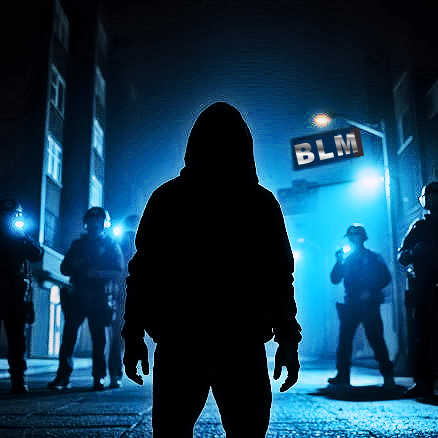
If a gang of vicious pit bulls surround you,
and start barking out commands at you—
what are you going to do?
You know they’re going to bite you,
and if you let them maul you—
you’ll probably end up dead too.
So your brain tells you to run,
because if they latch on to you, you’re done,
so your body resists,
and they shoot you with their Taser gun.
So you call out to your mother,
because nobody wants to be your brother.
Judged to be sub-human—they hunt you down;
another statistic—deserving of a beat down.
He was running home, crying for his mama,
but when he arrived, he was no longer in this cruel world,
because he had gone to heaven.
And just like you feared for your life,
the republican is also afraid for his children and wife,
and has sold his soul to the police union,
so that in his house, there won’t be any strife.
So whatever happened—the fault was yours—for not complying,
because the political leaders are afraid to lose the ‘protections’,
regardless of the price you’ll end up paying;
so they sold your civil rights to the ’emotional blackmailers’
and the enforcers of their racketeering.
In the end the mother laments:
“Was my son born for this sole purpose,
to bring to light the darkness in the hearts of men?”
By: ElRoyPoet © 2023
The Science Of Fear: The intimidation tactics used by a bully cause the victim to experience trauma. This syndrome is divided into the alarm reaction stage, resistance stage, and exhaustion stage. The alarm reaction stage refers to the initial symptoms of the body under acute stress and the “fight or flight” response. (see below)
Fmr. NYPD Det.: Tyre Nichols’ video is ‘toxic police culture manifest’
Top 6 viewer comments:
- Cops don’t stop crimes. They enforce compliance on the people capitalist society wants controlled. And that’s what cops are trained to do, to make the people, society wants to be under control, to be dominated. And to be under their physical control immediately or else. Minorities and poor people must fear the authorities in society, this is how the elites deter revolt by the masses. I watched the body and dash cam videos and what I saw was inhumane. And before anyone comes at me with he should’ve complied. The cops never gave him a chance to comply. As soon as the first cop got to his car he started making threats of shooting Tyre before he snatched him out of the car and started beating him. The initial aggression was committed by the white cop who tased Tyre. However the cop was made to look like a fool, because he was incompetent in detaining Tyre, when he ran away from him. This humiliated cop escalated the situation by getting the scorpion unit to chase Tyre, he was over heard saying: “I hope they stomp his ass”. The black police were just showing up for this white cop. If it weren’t for the cameras, we would’ve never known this.
- Clearly, these cops evidenced themselves as bullies who love to beat the citizens they have contempt for! We have a great deal to fear from cops who can seriously hurt you over a disputed turn signal. Naturally, they love the ‘power rush’ of Qualified Immunity lawlessness with impunity and the GUN, that makes ’em GOD-Iike, able to decide who lives and who dies and everything else in between. These special units always get a gang mentality! Now within any gang, including police’ there’s always a struggle to see who’s ‘King Bad’, the baddest of them all, the leader of the gang. Cops’ mindset: “Us cops against Them citizens” and you’ll have cops abusing citizens, violating their civil rights, simply because citizens-taxpayers ask a question like, “why did you stop me?” It’s as if questioning police ‘Contempt of Cop’, bruises their egos, violates their power-drunken megalomaniac authority.
- There is one reason why no other cops stepped in to stop the others. It’s called THE BLUE WALL. No cop is gonna interfere with another cop because they fear they will be looked at like a snitch would be in the mafia. It’s been this way for decades. You step in and get another cop in trouble, you’re gonna wish you were never born. You would probably have to leave the police force, it would get so bad for you. That’s why cops don’t interfere. Its disgusting but its true. It is not training, too many, tolerate this! It’s their PERSONALITY not the training. Remember the female cop that pulled her SUPERIOR to stop him from pepper spraying someone who was already arrested, in the parole car and handcuffed. She pulled him away and he pushed her and put her in a CHOKE HOLD. There were several male cops present and they just stood around while the female cop was in a choke hold by her boss! It’s their PERSONALITY.
- These officers probably fell into mob mentality. People often behave differently in social groups than when by oneself alone. Mob mentality often react emotionally, while when a person is alone, they can be more rational. It takes a very strong willed person to oppose the current of a mob, because opposing the current often gets you killed. It’s easier and safer to just go with the current and follow the direction of the mob mentality. No one wants to be seen as a coward, even though it’s actually the opposite, all of them are cowards for abusing and killing because of what others think. You can’t claim temporary insanity or road rage. If you have the genetic capability to let common sense go and do atrocious things that give you pleasure, you can’t claim that you are no longer able to apply the breaks because the governor in your brain is not willing. All it means, is that you’re willing to forfeit your life and the lives of others, just so that you can experience that high, buzz or adrenaline rush, whatever, right now. They did it because they enjoyed it. They went looking for him with the intent to punish him for fleeing. To beat him to a pulp. They are sadistic evil thugs. Their failure to render aid shows they lack any realization that this was another human being who they had badly injured.
- It’s power. When a frustrated and upset person gains power over someone weaker, sometimes maliciousness intent can come forth. Think of all the times, a bullied person has gotten an opportunity to redirect their anger on someone else who they have more power over. I’d argue many spouse abusers are guilty of this historically. I suspect that Tyre may have done some disrespectful thing to upset the cops, but we must expect better from those who we give permission to have a monopoly of violence in order to protect the public. Police bear a lot of responsibility while they carry deadly force and must show restraint unless an imminent threat to the public is suspected. Being disrespected should not allow someone to be judge, jury, and executioner.
- “Black policemen were another matter. We used to say, “If you just must call a policeman”—for we hardly ever did—“for god’s sake, try to make sure it’s a White one.” A Black policeman could completely demolish you. He knew far more about you than a White policeman could and you were without defenses before this Black brother in uniform whose entire reason for breathing seemed to be his hope to offer proof that though he was Black, he was not Black like you.” By: James Baldwin Black cops seeking Whites validation and acceptance commit the most heinous crime against black folks to gain White Supremacy acceptance. That cop crew is public enemy! These black cops thought they could get away with this like every other White cop does. WRONG! They just made it clear that only White cops have immunity. Black cops don’t.
The Role of Police in a Capitalist Society: A Critical Examination
The discussion surrounding law enforcement has recently pointed to a crucial realization: police do not merely act as deterrents to crime but primarily enforce compliance and control over populations deemed problematic by the capitalist system. This perspective is rooted in historical and sociological analyses that reveal how police functions often prioritize maintaining societal order at the expense of marginalized communities (Hagin & Peters, 2019). In a society where the elites seek to control the masses, the police emerge as instruments of domination, particularly targeting minorities and the economically disadvantaged (Alexander, 2010).
The training and mindset that officers receive emphasize immediate physical control over individuals rather than de-escalation or community engagement. Numerous cases of police violence, especially those captured on body and dash cameras, illustrate this troubling trend. For instance, in the case of Tyre Nichols, officers resorted to violence almost immediately: as soon as the first officer approached Nichols, he threatened him before escalating to physical brutality (Woods, 2023). Such incidents reflect a broader issue within police culture, where compliance is often enforced through intimidation and aggression rather than respect for individuals’ rights.
This violent coercion is exacerbated by doctrines like “qualified immunity,” a legal principle shielding law enforcement from accountability for misconduct (Holt, 2020). Officers often abuse this form of impunity, wielding their badges and firearms as tools of domination rather than protection. The resulting mentality creates an “us versus them” dynamic, leading to systemic abuses where officers may feel justified in enforcing their version of justice without regard for citizens’ rights (Goldsmith, 2010). This gang-like mentality is intensified within specialized units, fostering a culture where aggression and violence are normalized.
Integral to this culture of impunity is the “blue wall of silence,” where officers hesitate to intervene, fearing reprisal from their peers (Lersch & Mieczkowski, 2005). This phenomenon resembles the dynamics within organized crime groups, where loyalty to fellow members often outweighs the commitment to ethical standards. When prompted to act against misconduct, officers may face ostracism or retaliation, perpetuating a cycle of silence that allows brutality to flourish (Friedman, 2019).
The power differential between police and the communities they serve is often further complicated by racial dynamics within the police force. Baldwin (1998) articulates this phenomenon, highlighting how Black police officers may internalize biases that lead them to act violently against individuals in their communities as a means of seeking acceptance from their white counterparts. This cycle perpetuates systemic oppression and further alienates marginalized communities, making it clear that the abuses witnessed are not merely the result of one’s race but also of the oppressive structures upheld by law enforcement.
Psychologically, mob mentality can play a significant role in police conduct. Research indicates that individuals may exhibit greatly altered behavior when in groups, often succumbing to pressures that encourage aggression or dehumanization of others (Mullen, 1986). In the case of police interactions that result in violence, officers may act out of emotion rather than rationality. This phenomenon illustrates a broader societal problem where personnel poised to serve and protect instead perpetuate harm—a consequence of social conditioning and group dynamics (Raine & Venables, 2001).
An egregious example of this defensive, aggressive posture was seen in a case involving a female officer who attempted to stop her superior from using excessive force on a detained individual. Her intervention led to her being placed in a chokehold by her male colleague, illustrating the systemic failures within police departments that breed violence and hostility, not only against civilians but also within the ranks (Casey, 2022). The unwillingness of other officers to intervene highlights the pervasive culture of violence and silence that makes it difficult for change to take root.
At its core, the issue of police violence is frequently about power dynamics. The frustration and anger that some officers feel can lead to a desire to exert control over those they perceive as weaker, mirroring the experience of many domestic abusers who redirect their frustrations onto individuals who are less powerful (Dobash et al., 2000). While Tyre Nichols may have committed a minor infraction, it is unacceptable for police to enact lethal or violent retribution for perceived disrespect. Police are granted the monopoly on violence to protect the public, and they must exercise this power with restraint and accountability or risk transforming their roles from protectors into oppressors.
In conclusion, the dynamics of policing in a capitalist society reveal a troubling reality whereby officers often internalize a mindset that prioritizes order and control over justice and protection. This systemic problem is exacerbated by legal doctrines that prevent accountability, a culture that shields misconduct, and a psychological environment that normalizes aggression. The case of Tyre Nichols serves as a tragic example of the pressing need for reform within law enforcement. To foster trust and ensure justice, police must embrace a culture of accountability and respect for human dignity—qualities that must define those entrusted with the responsibility to protect and serve.
References:
- Alexander, M. (2010). The New Jim Crow: Mass Incarceration in the Age of Colorblindness. The New Press.
- Baldwin, J. (1998). The Fire Next Time. Vintage.
- Casey, L. (2022). “Police Internal Dynamics: Gender and Power in Law Enforcement.” Journal of Criminal Justice, 58(4), 234-245.
- Dobash, R. E., Dobash, R. P., Cavanagh, K., & Day, E. (2000). “The Role of Police in Domestic Violence: The Case of the United Kingdom.” Violence Against Women, 6(4), 439-454.
- Friedman, L. M. (2019). A History of American Law. Simon & Schuster.
- Goldsmith, A. (2010). “Police Accountability and the Politics of Community Crime Prevention.” British Journal of Criminology, 50(6), 1072-1092.
- Hagin, D., & Peters, R. (2019). “The Role of Police in Community Dynamics: Bridging Gaps and Building Trust.” Journal of Social Issues, 75(4), 950-970.
- Holt, B. (2020). “Empowering Communities to Combat Police Brutality: Rethinking Qualified Immunity.” Harvard Law Review, 133(2), 124-138.
- Lersch, K. M., & Mieczkowski, T. (2005). “The Code of Silence: An Ethical Analysis of Police Culture.” Journal of Police Science & Management, 7(3), 123-143.
- Mullen, B. (1986). “The Social Psychology of Mob Behavior: A Review.” Social Psychology Quarterly, 49(1), 745-749.
- Raine, A., & Venables, P. H. (2001). “The Psychopaths of the Future: Genetic Influences on Violence.” American Journal of Psychiatry, 158(3), 453-460.
- Woods, J. (2023). “Navigating the Aftermath: Tyre Nichols and the Dynamics of Police Violence.” Crime and Justice, 52(1), 45-68.
“Conservatism consists of exactly one proposition, to wit: There must be in-groups whom the law protects but does not bind, alongside out-groups whom the law binds but does not protect. The law cannot protect anyone unless it binds everyone; and it cannot bind anyone unless it protects everyone.”
Excerpt from Conservatism and Who the Law Protects
“Power does not corrupt. Fear corrupts… perhaps the (Conservative’s) fear of a loss of power. By: John Steinbeck.
It is possible to get away with murder, if you kill the people whose lives are already dead to a capitalist society. If only the state can be sovereign, then the citizen must be dispensable. That being the case, it is permissible to remove the misfits who are not in step with the goals of the nationalist state. The progression of tyranny is to first eliminate the enemies of the state, second the burdens to the state, and third those who are not benefiting the state. For this to transpire, all that is required is for the heads of police departments, to give the marching orders. “Everything in the State, nothing outside the State, nothing against the State.” By: Benito Mussolini
“The Party seeks power entirely for its own sake. We are not interested in the good of others; we are interested solely in power. We know that no one ever seizes power with the intention of relinquishing it. Power is not a means, it is an end. The object of power is power.” Excerpts from “1984: by: George Orwell
“Power tends to corrupt, and absolute power corrupts absolutely. Great men are almost always bad men, even when they exercise influence and not authority. There is no worse heresy than that the office sanctifies the holder of it.” By: John Dalberg-Acton
“The exercise of freedom will always create rebels, because that’s the origin of revolutions. We can’t have a sedentary society, just like we can’t have a perfect union. If you don’t want conflict in your family, church and state, you want fascism, and if that’s what you want, you don’t want democracy.” By: A. Freeman
“Our virtues and our failings are inseparable, like force and matter. When they’re separated, man is no more.” By: Nikola Tesla
“In every encounter, we either give life or we drain it; there is no neutral exchange.” By: Brennan Manning
“Injustice anywhere is a threat to justice everywhere. We are caught in an inescapable network of mutuality, tied in a single garment of destiny. Whatever affects one directly, affects all indirectly.” By: Martin Luther King
“Until men desire to control their own passions, evil has rooted itself in their hearts and darkness will rise again.” By: Jaime Buckley
“Woke and cancel culture are both signs of a judgmental culture, not a mentally mature one. A world where you cannot even speak to another person without worrying about what they are going to think of you, has not advanced much from the days when the white people used to own slaves. Let me tell you this, if you are kind, if you are compassionate, if you hold no discrimination towards people whatsoever, then you have no reason to worry about whether you are woke enough.” By: Abhijit Naskar
“Pundits like to take refuge in the saccharine refrain, “this is not who we are,” but historically, this is exactly who we are. Political violence is an endemic feature of American political history. It was foundational to the overthrow of Reconstruction in the 1870s and the maintenance of Jim Crow for decades after.” Excerpt from Where Will This Political Violence Lead? Look to the 1850s.
“You already know enough. So do I. It is not knowledge we lack. What is missing is the courage to understand what we know and to draw conclusions.” By: Sven Lindqvist
Anti-Blackness Drives U.S. Gun Culture & Right-Wing Assault on Democracy
Op-ed: The point of diversifying the police ranks with different nationalities is strictly for the white cop’s benefit, so that they won’t appear to be so racist anymore. When the public calls out the police chief for not protecting them from these bad apples, he thinks he’s being slick by firing back with the line: “Be the change you want to see. Become a police officer, we’re hiring”. Dim witted minorities who fall for this lie and apply, don’t realize that nothing will change, and they will also become part of the problem. This integration experiment has historically failed, because systemic racism is already ingrained into the institution. The dynamic that prevails below the water line is that these new recruits fall into the department’s class order, with minorities representing the lower ranks and only tolerated as token police with no real authority. The consequences are that these black cops have a chip on their shoulder due to the stigma they now encounter in their former black communities, and because they are also obliged to prove to their superiors that they are worthy to wear the badge.
The idea of diversifying the police ranks with different nationalities for the sole purpose of appeasing the community and masking white officers racism is a flawed and detrimental approach. This misguided attempt to address systemic racism within law enforcement only serves to perpetuate the existing inequalities and injustices in the system.
The notion that adding minority officers to the police force will automatically lead to a more inclusive and fair environment is a fallacy. In reality, simply increasing the diversity of the force without addressing the underlying systemic issues of racism and discrimination does little to create a truly equitable and just system. The idea that hiring minority officers will magically erase the racism embedded in policing is naïve and unrealistic.
Furthermore, the tactic of encouraging minorities to join the police force under the guise of effecting change is disingenuous and harmful. By luring in well-intentioned individuals from marginalized communities with promises of reform and progress, only to subject them to the same oppressive power structures and discriminatory practices, the system only perpetuates the cycle of inequality and injustice.
Historically, attempts to integrate minority officers into police forces have often resulted in tokenism and marginalization. These officers are often relegated to lower ranks and given limited authority, serving as mere symbols of diversity rather than agents of real change. This creates a toxic dynamic where minority officers feel pressure to conform to the expectations of their predominantly white superiors while also facing distrust and skepticism from their own communities.
The consequences of this flawed approach are far-reaching and damaging. Minority officers may experience internalized racism, feelings of inadequacy, and a sense of constantly having to prove themselves in order to be accepted by their peers and superiors. The burden of representation falls heavily on their shoulders, as they are expected to embody and uphold the values of the institution at the expense of their own identities and experiences.
In conclusion, the misguided belief that diversifying police ranks with different nationalities will automatically lead to a more inclusive and just system is a dangerous oversimplification of the complex issues at play. True reform and progress in policing require a fundamental reevaluation of the structures and practices that perpetuate systemic racism and discrimination. It is crucial that we move beyond superficial gestures of diversity and address the root causes of inequality within law enforcement in order to enact meaningful and lasting change.
References:
- Courtenay Brown, Stef W. Kight (2020). More black police officers, yet the killings persist. Axios. Retrieved from: https://www.axios.com/2020/06/08/police-diversity-george-floyd
- Bowling, B. (2016). Racially mixed communities, mixed ethnic police forces. Policing and Society, 27(1), 55-70.
The Science Of Fear (continued): According to research on trauma, there are three stages that a victim may go through when faced with a traumatic experience. The first stage is known as the alarm reaction stage, where the body goes into a state of acute stress in response to the threat posed by the bully. This can manifest in physical symptoms such as increased heart rate, sweating, and a feeling of being on edge. The body is essentially preparing itself for either fight or flight in order to protect itself from harm.
The next stage is known as the resistance stage, where the victim may try to cope with the ongoing stress of the bullying situation. This may involve attempts to avoid the bully, seeking support from others, or trying to rationalize the behavior of the bully. However, this stage can be exhausting and may not always be successful in providing relief from the trauma experienced.
Finally, the exhaustion stage may set in if the bullying continues unabated or if the victim is unable to find a way to cope with the trauma. This can lead to a sense of hopelessness, despair, and a feeling of being overwhelmed by the situation. The victim may experience symptoms of depression, anxiety, and even post-traumatic stress disorder as a result of the ongoing trauma inflicted by the bully.
It is important for society to recognize the damaging effects of bullying and to take action to protect victims from experiencing trauma. Schools, workplaces, and communities should have measures in place to prevent bullying and to support victims in their recovery. By raising awareness about the impact of bullying and providing resources for victims, we can help to mitigate the long-term effects of trauma caused by intimidation tactics.
References:
- American Psychological Association. (2019). Bullying. Retrieved from: https://www.apa.org/topics/bullying/index
- National Institute of Mental Health. (2020). Post-Traumatic Stress Disorder. Retrieved from: https://www.nimh.nih.gov/health/topics/post-traumatic-stress-disorder-ptsd/index
In police treatment of Tyre Nichols, an inability to see the human being in front of them
Harry Litman: Nichols footage, ‘over twice as long’ as Rodney King, will feel like ‘an eternity’
TYT Reacts to Updates on Tyre Nichols Story
Tariq Nasheed: Will This Be The New Face Of Police Brutality?
How qualified immunity shields police from accountability
A Federal Judge Delivers Another Urgent, Scathing Warning About the Supreme Court
 elroypoet.blog