

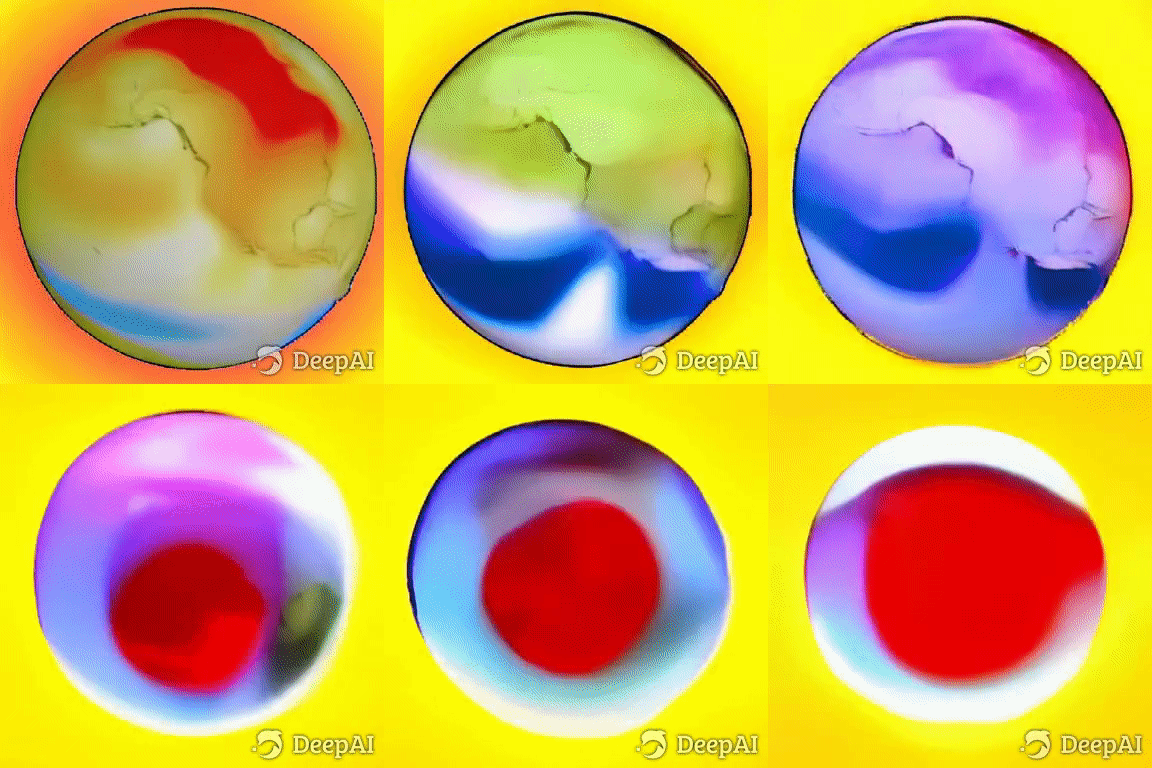
I’ve traveled across countless galaxies,
seen stars glow bright,
and others grow dim.
It’s been my experience,
that a sun burns hotter—
before it burns out.
I’ve even seen frozen planets
swallowed whole,
by the very same darkened hole.
By: ElRoyPoet © 2020
Does Air Pollution cause Global Warming?
In shadows cast by corporate lies,
I’ve watched heated arguments arise—
Climate change, they swear it’s fake,
A diversion—they craft and make.
While voices clash and theories fight,
The skies darken with menacing blight,
A silent killer, unseen, yet near—
Pollution’s march, year upon year.
My fellow beings’ lives cut short,
By fumes and smog, a deadly sport—
A grave statistic, impossible to ignore,
An EPA crisis knocking at our door.
Global warming—a smoke-screen guise,
Hiding dangers beneath the skies—
While I argue, contest, debate,
The air grows thicker, sealing my fate.
Regulations weaken, laws are bent,
While toxins spread, and lives are spent—
The silent game for greedy gain,
Profiting while we endure suffocating pain.
The weather’s not the only fight,
That makes my lungs cry in the night—
Factories, emissions, endless drain,
Pollution’s toll—pouring down like acid rain.
The discussion is over—the truth is plain,
The fight for oxygen is ours to claim.
We must stand firm, expose the sham—
And demand clean air across the land.
Clean Air First: Don’t Let the Global Warming Debate Distract you from the Real Culprit — Deadly Pollution
As a concerned citizen, I have watched the global warming debate unfold for years, and a disturbing pattern has emerged. Powerful corporations and their government sympathizers are using the controversy as a smokescreen—distracting the public from a more immediate and tangible danger: the steady deterioration of our air quality from man‑made pollutants.
They frame climate science as “fake news,” casting doubt where urgent action is needed and, in effect, trying to kill two birds with one stone: discredit the climate discussion while continuing to pollute with impunity. They count on public fatigue—hoping activists, politicians, and citizens will tire of a seemingly no‑win debate. Those who remain engaged are pushed toward extremes—resigned apathy or militant activism—while emissions keep flowing unchecked.
The scale of the harm is not abstract. The World Health Organization estimates that air pollution (outdoor and household) is linked to around 6.7–7 million premature deaths annually; ambient (outdoor) air pollution alone caused an estimated 4.2 million premature deaths in 2019 (cardiovascular disease, respiratory illness and cancer are major contributors). These staggering figures demand concrete responses now, not only long‑term climate arguments (WHO; 2019–2024).1,2
By pouring energy into endless arguments over whether the planet is warming, we risk ignoring the proximate, measurable cause of many health and environmental crises: unregulated emissions that foul our air and raise local temperatures. Recent research also shows that fossil‑fuel combustion alone is responsible for millions of deaths each year, underlining how co‑emitted pollutants from the same sources blamed for greenhouse‑gas emissions have immediate health consequences (Harvard et al.; 2019–2021).3
Corporations have a vested interest in perpetuating the global warming debate. The longer public attention is diverted, the longer harmful practices continue without stringent enforcement under laws intended to protect air and water. Regulatory gaps and political cover allow smokestacks to keep belching and tailpipes to keep poisoning neighborhoods—often the same communities least able to fight back. This is not merely rhetorical: data on pollutant emissions, industry lobbying, and uneven enforcement show how corporate influence can blunt effective regulation.4
Make no mistake: rising global temperatures are a grave concern with deep, long‑term consequences. But while scientists untangle climate feedbacks and forecast future risks, people today are choking on smog, suffering asthma attacks, and dying prematurely from pollution‑linked illnesses. The presence of hazy skies and particulate‑laden air is not conjecture—it is palpable, measurable, and urgent. Reducing particulate matter (PM2.5), nitrogen oxides, sulfur dioxide and volatile organic compounds yields immediate public‑health benefits while also contributing to climate mitigation where sources overlap.1,2
We should redirect more of our collective effort toward improving air quality now. That means: enforce emissions standards rigorously; close regulatory loopholes; hold corporations accountable through transparent monitoring, penalties, and remediation; and accelerate investment in cleaner industrial processes, renewable energy, and low‑emission transportation. Such measures produce quick reductions in mortality and morbidity and build momentum toward longer‑term climate goals.1,3
The rhetoric of greenwashed PR campaigns cannot distract us from real‑world consequences. The primary enemy at our door is not abstract debate; it is pollution that renders air unbreathable and blurs our horizons. The time for equivocation has passed. We must move from talk to tangible action—demand stronger enforcement, support evidence‑based legislation that curbs emissions, and prioritize cleaner alternatives that protect communities now and preserve the planet for future generations.
References:
- World Health Organization (WHO). “Ambient (outdoor) air pollution” fact sheet (updated Oct 2024): ambient air pollution estimated to cause 4.2 million premature deaths in 2019; combined outdoor and household air pollution ~6.7 million premature deaths annually.
- World Health Organization. “Air pollution: the invisible health threat” / Global air quality guidance and reports (WHO pages summarizing air‑pollution burden, 2019–2024).
- Harvard T.H. Chan School / peer‑reviewed studies on fossil‑fuel mortality attribution (e.g., research attributing millions of deaths to fossil‑fuel combustion; press summaries 2021). See: “Fossil fuel air pollution responsible for 1 in 5 deaths worldwide” (Harvard Chan News, Feb 2021) and linked study.
- Data reviews and analyses (Our World in Data) summarizing estimates of deaths from air pollution, causes, and trends; plus literature on industry influence and regulatory enforcement disparities.
Annotated bibliography:
World Health Organization. “Ambient (outdoor) air pollution and health” fact sheet. Updated Oct 2024.
- Presents global estimates of premature deaths attributable to ambient and household air pollution, disease burden by pollutant (PM2.5), and recommendations for policy action.
- Supports the claim about millions of premature deaths and the health impacts of particulate pollution.
World Health Organization. “Air pollution” topic page and global reports (2019–2024).
- Aggregates WHO guidance, technical reports, and global air‑quality assessments; includes evidence on exposure pathways and mitigation strategies.
- Provides authoritative context for linking air pollution to immediate public‑health harms and policy interventions.
Heft‑Neal, S., Burney, J., Bendavid, E., & Burke, M. “Fossil fuel air pollution and mortality.” Harvard T.H. Chan School of Public Health summary and linked peer‑reviewed study. Feb 2021.
- Summarizes research attributing a substantial share of global premature deaths to pollution from fossil‑fuel combustion; discusses methods for source attribution.
- Substantiates the link between fossil‑fuel emissions, co‑pollutants, and large-scale mortality.
Lelieveld, J., Evans, J. S., Fnais, M., Giannadaki, D., & Pozzer, A. “The contribution of outdoor air pollution sources to premature mortality on a global scale.” Nature (2015) and follow‑up analyses.
- Peer‑reviewed study quantifying global mortality attributable to different air‑pollution sources and regions; widely cited in policy discussions.
- Offers empirical backing for statements about source‑specific impacts and the urgency of emissions reductions.
Our World in Data. “Air pollution” overview page and data visualizations.
- Presents compiled datasets, trends, and visualizations for PM2.5, deaths, and policy indicators across countries.
- Useful for comparative data and trends supporting claims about measurable air‑quality decline and health outcomes.
Union of Concerned Scientists / Environmental Defense Fund reports on industry lobbying and regulatory enforcement (selected briefs, 2018–2023).
- Documents industry influence on environmental regulation, case studies of lobbying campaigns, and examples of enforcement disparities.
- Supports assertions about corporate interests, regulatory capture, and how distraction tactics can delay enforcement.
U.S. Environmental Protection Agency. “Clean Air Act” overview and enforcement statistics.
- Describes the Clean Air Act’s regulatory framework, enforcement mechanisms, and historical impact on emissions reductions in the U.S.
- Provides legal context for calls to strengthen enforcement and close loopholes.
Solar punk is not… here’s what it actually is.
“As for you, my flock, this is what the Sovereign Lord says: ‘I will judge between one sheep and another, and between rams and goats. Is it not enough for you to feed on the good pasture? Must you also trample the rest of your pasture with your feet? Is it not enough for you to drink clear water? Must you also muddy the rest with your feet? Must my flock feed on what you have trampled and drink what you have muddied with your feet?'” Bible, Ezekiel 34:17-19
The earth turns gaunt and gray,
the world silent and sad,
sky and land lifeless, colorless.
Earth Polluted by Its Very Own People
Earth is polluted by its very own people,
who have broken its laws,
Disrupted its order,
violated the sacred and eternal covenant.
Therefore a curse, like a cancer,
ravages the earth.
Its people pay the price of their sacrilege.
They dwindle away, dying out one by one.
The Message, Isaiah 24:4-6
Devastating toxic spill seen as test of whether African countries will stand up to China
Poem Analysis: A Reflection on Stars and Existence
The poem invites readers to explore themes of cosmic wonder, the transience of existence, and the cyclical nature of stellar life. Through evocative imagery and profound insight, the poem mirrors scientific principles while exploring philosophical implications that arise from our understanding of the universe.
Cosmic Travels and the Vastness of the Universe
The opening line, “I’ve traveled across countless galaxies” establishes a grand setting that evokes the vastness of the cosmos. In an astronomical context, a galaxy is defined as a massive system of stars, stellar remnants, and dark matter, bound together by gravity. The observable universe contains over two trillion galaxies (Hubble Space Telescope, 2016). This immense scale emphasizes the poem’s exploration of human curiosity and the innate desire to understand one’s place within the larger cosmic tapestry.
The Life Cycle of Stars
The subsequent lines, “seen stars glow bright / and others grow dim,” speak to the life cycle of stars, which is a central tenet of astrophysics. Stars are born from clouds of gas and dust, undergoing nuclear fusion that causes them to shine brightly. Over time, as they exhaust their nuclear fuel, they undergo significant changes, often culminating in phenomena such as supernovae or the dimming of their light as they transition into white dwarfs or neutron stars.
The phrase “a sun burns hotter / before it burns out” poignantly encapsulates the concept of stellar evolution. For instance, our sun is currently in the main sequence stage, shining bright due to the fusion of hydrogen into helium. As it progresses to the red giant phase, it will indeed increase in luminosity and temperature before ultimately shedding its outer layers and leaving behind a dense core—its final resting place as a white dwarf (Kippenhahn & Weigert, 1990).
Cosmic Consumption: Black Holes
The following lines, “I’ve even seen frozen planets / swallowed whole, / by the very same darkened hole,” delve into the enigmatic phenomenon of black holes. Formed from the remnants of massive stars that have undergone supernova explosions, black holes exhibit gravitational fields so strong that not even light can escape. The image of “frozen planets” being consumed by black holes reflects scientific observations of accretion disks, where matter spirals into black holes, often resulting in significant energy emissions (Thorne, 1994). The poem’s metaphorical language captures both the physical destruction and the metaphorical consumption of celestial bodies, evoking feelings of awe and existential pondering.
Philosophical Implications: Transience and Transformation
Beyond the scientific references, the poem also prompts a philosophical reflection on the transient nature of existence. The radiant life of stars serves as a metaphor for the human experience: vibrant and full of potential, followed inevitably by decline and transformation. The observation that bright stars often have shorter lifespans than dim ones raises questions about the nature of legacy, impact, and cosmic significance.
In this way, the poem serves as a microcosm of human existence, set against the eternal backdrop of the universe. The struggle between creation and annihilation, brightness and darkness, can be interpreted as a commentary on the human condition—our fleeting lives, our achievements, and the way they contribute to the collective narrative of life.
In conclusion, the poem weaves a rich tapestry of astronomical truths and philosophical musings. By drawing on scientific principles related to the life cycles of stars, the formation of black holes, and the vastness of the universe, the poem resonates with the reader on multiple levels. It compels us to confront the mysteries of existence, the inevitable passage of time, and how all things are connected—a reminder that, much like the stars, our lives are moments of brilliance within the infinite cosmos. Through this exploration, the poem reaffirms the beauty and complexity that lies at the intersection of science and poetry.
References:
Hubble Space Telescope. (2016). “Hubble’s Greatest Discoveries.”
Kippenhahn, R., & Weigert, A. (1990). Stellar Structure and Evolution.
Thorne, K. S. (1994). Black Holes and Time Warps: Einstein’s Outrageous Legacy.
There Are 10,000 Active Satellites In Orbit. Not Space Pollution, Too!
 elroypoet.blog