

Your plan is to overcome the world’s desire,
But you feel your resolve is not enough.
What matters most is not what you think,
But how you imagined divinity would come.
For every god’s life is a wondrous journey,
But when you stray from the sacred path:
Your case for faith becomes forsaken,
When your mortal fears are undertaken.
By: ElRoyPoet © 2024
Our Eternal Life – What Do Latter-day Saints Believe?
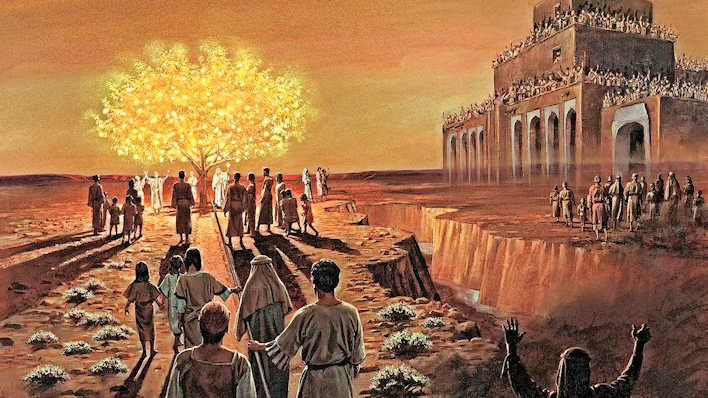
“And I beheld a rod of iron, and it extended along the bank of the river, and led to the tree by which I stood. And I also beheld a strait and narrow path, which came along by the rod of iron, even to the tree by which I stood; and it also led by the head of the fountain, unto a large and spacious field, as if it had been a world. And I saw numberless concourses of people, many of whom were pressing forward, that they might obtain the path which led unto the tree by which I stood. And it came to pass that they did come forth, and commence in the path which led to the tree. And it came to pass that there arose a mist of darkness; yea, even an exceedingly great mist of darkness, insomuch that they who had commenced in the path did lose their way, that they wandered off and were lost. And it came to pass that I beheld others pressing forward, and they came forth and caught hold of the end of the rod of iron; and they did press forward through the mist of darkness, clinging to the rod of iron, even until they did come forth and partake of the fruit of the tree. And after they had partaken of the fruit of the tree they did cast their eyes about as if they were ashamed. And I also cast my eyes round about, and beheld, on the other side of the river of water, a great and spacious building; and it stood as it were in the air, high above the earth. And it was filled with people, both old and young, both male and female; and their manner of dress was exceedingly fine; and they were in the attitude of mocking and pointing their fingers towards those who had come at and were partaking of the fruit. And after they had tasted of the fruit they were ashamed, because of those that were scoffing at them; and they fell away into forbidden paths and were lost. And now I, Nephi, do not speak all the words of my father. But, to be short in writing, behold, he saw other multitudes pressing forward; and they came and caught hold of the end of the rod of iron; and they did press their way forward, continually holding fast to the rod of iron, until they came forth and fell down and partook of the fruit of the tree. And he also saw other multitudes feeling their way towards that great and spacious building. And it came to pass that many were drowned in the depths of the fountain; and many were lost from his view, wandering in strange roads. And great was the multitude that did enter into that strange building. And after they did enter into that building they did point the finger of scorn at me and those that were partaking of the fruit also; but we heeded them not. These are the words of my father: For as many as heeded them, had fallen away.” Book of Mormon, 1 Nephi 8:19-34
“And it came to pass that they did speak unto me again, saying: What meaneth this thing which our father saw in a dream? What meaneth the tree which he saw? And I said unto them: It was a representation of the tree of life. And they said unto me: What meaneth the rod of iron which our father saw, that led to the tree? And I said unto them that it was the word of God; and whoso would hearken unto the word of God, and would hold fast unto it, they would never perish; neither could the temptations and the fiery darts of the adversary overpower them unto blindness, to lead them away to destruction. Wherefore, I, Nephi, did exhort them to give heed unto the word of the Lord; yea, I did exhort them with all the energies of my soul, and with all the faculty which I possessed, that they would give heed to the word of God and remember to keep his commandments always in all things. And they said unto me: What meaneth the river of water which our father saw? And I said unto them that the water which my father saw was filthiness; and so much was his mind swallowed up in other things that he beheld not the filthiness of the water. And I said unto them that it was an awful gulf, which separated the wicked from the tree of life, and also from the saints of God. And I said unto them that it was a representation of that awful hell, which the angel said unto me was prepared for the wicked. And I said unto them that our father also saw that the justice of God did also divide the wicked from the righteous; and the brightness thereof was like unto the brightness of a flaming fire, which ascendeth up unto God forever and ever, and hath no end. And they said unto me: Doth this thing mean the torment of the body in the days of probation, or doth it mean the final state of the soul after the death of the temporal body, or doth it speak of the things which are temporal? And it came to pass that I said unto them that it was a representation of things both temporal and spiritual; for the day should come that they must be judged of their works, yea, even the works which were done by the temporal body in their days of probation. Wherefore, if they should die in their wickedness they must be cast off also, as to the things which are spiritual, which are pertaining to righteousness; wherefore, they must be brought to stand before God, to be judged of their works; and if their works have been filthiness they must needs be filthy; and if they be filthy it must needs be that they cannot dwell in the kingdom of God; if so, the kingdom of God must be filthy also. But behold, I say unto you, the kingdom of God is not filthy, and there cannot any unclean thing enter into the kingdom of God; wherefore there must needs be a place of filthiness prepared for that which is filthy. And there is a place prepared, yea, even that awful hell of which I have spoken, and the devil is the preparator of it; wherefore the final state of the souls of men is to dwell in the kingdom of God, or to be cast out because of that justice of which I have spoken. Wherefore, the wicked are rejected from the righteous, and also from that tree of life, whose fruit is most precious and most desirable above all other fruits; yea, and it is the greatest of all the gifts of God. And thus I spake unto my brethren. Amen.” 1 Nephi 15:21-36
“They are they who are the church of the Firstborn. They are they into whose hands the Father has given all things—They are they who are priests and kings, who have received of His fullness, and of His glory; And are priests of the Most High, after the order of Melchizedek, which was after the order of Enoch, which was after the order of the Only Begotten Son. Wherefore, as it is written, they are gods, even the sons of God—Wherefore, all things are theirs, whether life or death, or things present, or things to come, all are theirs and they are Christ’s, and Christ is God’s. And they shall overcome all things. Wherefore, let no man glory in man, but rather let him glory in God, who shall subdue all enemies under his feet. These shall dwell in the presence of God and His Christ forever and ever. Doctrine and Covenants 76:54-62
What Is the Purpose and Meaning of Life?
The Plan of Salvation:
“As for you, you were dead in your transgressions and sins, in which you used to live when you followed the ways of this world and of the ruler of the kingdom of the air, the spirit who is now at work in those who are disobedient. All of us also lived among them at one time, gratifying the cravings of our flesh and following its desires and thoughts. Like the rest, we were by nature deserving of wrath. But because of His great love for us, God, Who is rich in mercy, made us alive with Christ even when we were dead in transgressions—it is by grace you have been saved. And God raised us up with Christ and seated us with Him in the heavenly realms in Christ Jesus, in order that in the coming ages He might show the incomparable riches of His grace, expressed in His kindness to us in Christ Jesus. For it is by grace you have been saved, through faith—and this is not from yourselves, it is the gift of God—not by works, so that no one can boast. For we are God’s handiwork, created in Christ Jesus to do good works, which God prepared in advance for us to do.” Ephesians 2, 1-10
“For God so loved the world that He gave His one and only Son, that whoever believes in Him shall not perish but have eternal life.” John 3:16
“This is love: not that we loved God, but that He loved us and sent His Son as An Atoning Sacrifice for our sins.” 1 John 4:10
“For just as rain and snow fall from heaven and do not return without watering the earth, making it bud and sprout, and providing seed to sow and food to eat, so My Word that proceeds from My Mouth will not return to Me void, but it will accomplish what I please, and it will prosper where I send it.” Isaiah 55:10-11
Why is it important to believe in biblical inerrancy?
Why Did Jesus Die on a Cross according to Philippians 2:8?
Poem Analysis:
The “The Desire for Immortality” invites readers to delve into the complexities of faith, desire, and the human struggle against worldly temptations. Each line serves as a tight-knit exploration of belief, introspection, and the tension between aspirations and reality. This summary explores the poem’s themes, structure, and philosophical implications.
At the outset, the speaker addresses a universal struggle: the aspiration to transcend the allure of worldly desires. The phrase “Your plan is to overcome the world’s desire” denotes an intention to rise above materialistic pursuits or superficial cravings, a goal that resonates with many spiritual traditions advocating for a life led by higher ideals. However, the subsequent phrase—“But you feel your resolve is not enough”—introduces a note of vulnerability and self-doubt. It suggests that the inner strength required to enact such a transformation is often insufficient, reflecting a common human experience where ambition clashes with reality and personal limitations.
In the next lines, the poem shifts focus from the individual’s desires to the nature of belief. “What matters most is not what you think, But how you imagined divinity would come.” Here, the poet emphasizes that the essence of faith may not merely reside in intellectual or theological convictions but in the vividness and sincerity of one’s imagination regarding the divine. The phrase asks a fundamental question about the nature of salvation and guidance: are they contingent upon a predefined set of beliefs, or do they arise from the way individuals envision and connect with the sacred? This distinction keeps the reader engaged with a pivotal realization that one’s conceptualization of divinity can shape their spiritual journey profoundly.
The subsequent lines broaden this introspective inquiry into a broader philosophical terrain. The assertion that “for every god’s life is a wondrous journey” aligns with various mythological and religious depictions where deities engage in adventures replete with trials and divine learning. Here, the journey stands as a metaphor for life itself—suggesting that existence is rich with experience, complexity, and growth, regardless of the divine context. However, the poem rapidly pivots with the cautionary warning: “But when you stray from the sacred path.” This line acts as a turning point; it denotes the potential dangers of diverging from one’s spiritual or moral direction—a theme resonant across different religious and philosophical frameworks which emphasize the importance of adhering to one’s values.
The lines that follow describe the tension between faith and the inevitability of human fears. The phrase “Your case for faith becomes forsaken, When your mortal fears are undertaken” signifies a retreat from faith when confronted with existential anxieties. Here, the poet poignantly articulates the dilemma many face: when nurtured by fear (of failure, loss, or the unknown), the very faith one seeks to uphold can become overshadowed, making the individual feel lost in their journey. The contrast between the ideals of faith and the burdens of human experience underscores the vulnerability tied to belief.
Ultimately, the poem presents a rich thematic tapestry woven through a series of reflections that question the nature of desire, define the essence of faith, and grapple with the fear inherent in the human condition. The speaker’s dialogue embodies the internal conflict between striving for a higher purpose and the constraints of reality, providing a nuanced exploration of spirituality. Through this examination, readers may be inspired to reflect on their own experiences with aspiration, faith, and the inevitable struggles of life, reminding them that the journey toward understanding the divine is profoundly personal and often fraught with challenges. In a world where desires frequently clash with aspirations of higher meaning, the poem resonates as a poignant inquiry into the depth of the human condition, striking chords of introspection and futility.

