

Last night, I had a dream. A traveling evangelist had come to town. He could have been a guru, an inspirational speaker, or even an apostle from a proselytizing church. I met him in the lobby after the conference. I asked him if he would answer one of the four questions I had written on a sheet of paper because I was on a quest to understand the mysteries of life. He asked me how many hours I was willing to dedicate to his cause. I said I was willing to spend as many hours as he wanted me to. So he wrote down the answer to one of my questions on another piece of paper. And after he did that, he took the sheet of paper with my four questions on it and put it in his mouth, chewed it up, and then spat it into a nearby trash can. I was puzzled by his odd behavior, but I didn’t object because I already had an answer to one of the questions on the other piece of paper in my hand.
And then we had a conversation about life and how hard it can be for some and not for others. Then he shared with me that all his life, from his youth until the present, he had endeavored to improve his environment or at least maintain a pleasant one in order to facilitate a better life experience for himself and those who surrounded him. I thanked him for taking some time out of his busy schedule to talk to me. After he was gone, I realized I didn’t know which question he had answered. So I looked at the sheet of paper he had given me, but it was blank.
When I woke up, I was still perplexed about the meaning of my bizarre dream. But then it occurred to me that even if the answer was written down, I still wouldn’t have known which of life’s greatest mysteries he had solved, because I didn’t know which question he had answered. And therefore, I wouldn’t be able to resolve anything by myself.
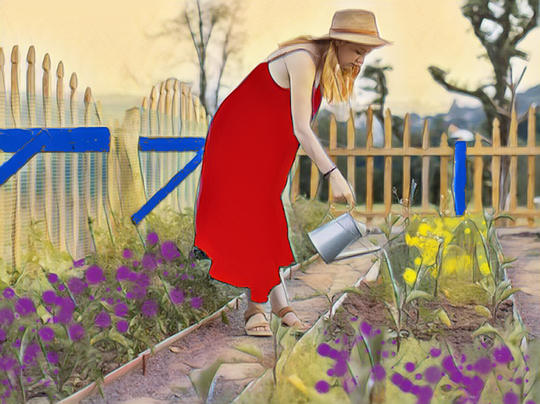
Why Voltaire Said: You Must Cultivate Your Own Garden
The Garden of Dialogue
In our quest for social order, we toil and we strive,
Trying to calm the fear, trying to heal the divide.
We argue to change minds, to make all things right.
But our efforts lead to quarrels and then to endless fights.
We break the bonds that tie us, with every new attempt,
And in our haste, we sacrifice culture’s noble intent.
We don’t listen to understand and forget how to share.
We don’t try to make peace, or even show we care.
Perhaps it’s not about our intelligence or even our might,
But rather how we choose to act, in the day and in the night.
To be civil in our speech, not just to be loud and bold,
To create an environment where equality can unfold.
Our purpose in life is not just to repair and change,
But to nurture progress, so that we can rearrange.
Our goal should be to cultivate a safe space,
Where peace and harmony can take their place.
For life has taught us, in the past and present,
That our joy or despair is in the environment,
We find ourselves in, at any moment’s glance.
So let’s tend the garden together and do a rain dance.
Let’s give what we have, let empathy be your guide.
Treat each other fairly, whatever the side.
For as long as we’re here, on this earth below,
Let’s show some kindness, so all our words will flow.
By: ElRoyPoet © 2024
The human desire to fix things, solve problems, and change other people’s minds is a fundamental aspect of human nature. However, sometimes this desire can lead to the opposite effect, causing more harm than good. In order to achieve true harmony and peace, it is essential to recognize when it is necessary to hold back and not impose our will on others.
One of the primary reasons why we may force the issue is because we believe we are right and others are wrong. This mindset can lead to a sense of superiority and a desire to impose our will on others. According to psychologist Abraham Maslow, “the need for self-esteem” is one of the most fundamental human needs (A). When we feel that our views are being challenged or ignored, our self-esteem can be threatened, leading us to become more rigid and dogmatic in our beliefs.
On the other hand, when we focus on understanding and respecting others’ perspectives, we can foster a more harmonious and peaceful environment. As the ancient Greek philosopher Aristotle said, “Educating the mind without educating the heart is no education at all” (B). By cultivating empathy and compassion, we can create an environment that encourages open communication and mutual understanding.
Another reason why we may force the issue is because we believe that our way is the only way. This mindset can lead to a sense of entitlement and a belief that others should conform to our views. According to social psychologist Albert Bandura, “the exercise of power often involves the suppression of others’ rights” (C). When we impose our ideology on others, we are not only undermining their autonomy but also creating an environment that is conducive to resentment and conflict.
In contrast, when we focus on creating an environment that is conducive to peace and harmony, we can foster a sense of community and cooperation. As Mahatma Gandhi said, “Be the change you wish to see in the world” (D). By working together towards a common goal, we can create an environment that is based on mutual respect and understanding. As Epictetus noted, “It’s not what happens to you, but how you react to it that matters” (E).
References:
A. Maslow, A. H. (1943). A theory of human motivation. Psychological Review, 50(4), 370-396.
B. Aristotle. (circa 350 BCE). Nicomachean Ethics. Book 1.
C. Bandura, A. (1990). Selective moral disengagement in the examination of moral justification of collective violence. Journal of Personality and Social Psychology, 59(3), 446-459.
D. Gandhi, M. K. (1913). To Hamilton Chagla. Quoted in The Wit and Wisdom of Mahatma Gandhi.
E. Epictetus. (circa 100 CE). Discourses.
“We must choose to live in this world and to project our own meaning and value onto it in order to make sense of it. This means that people are free and burdened by it, since with freedom there is a terrible, even debilitating, responsibility to live and act authentically. Every human is free, but freedom itself is relative; one must embrace limits, moderation, ‘calculated risk’; absolutes are anti-human. ‘I choose freedom. For even if justice is not realized, freedom maintains the power of protest against injustice and keeps communication open.’ If you are thoroughly committed to an idea, are you compelled to kill for it? [Is this is what happens when polarization takes hold of society?] What price for justice? What price for freedom? Absolutism, and the impossible idealism it inspires, is a dangerous path forward.” Excerpts from: How Camus and Sartre split up over the question of how to be free
The righteous care about justice for the poor, but the wicked have no such concern. Where there is no vision, the people perish… Many seek the ruler’s favor; but every man’s judgment comes from The Lord. There is a way that appears to be right, but in the end it leads to death. The simple believe anything, but the prudent give thought to their steps. The wise fear The Lord and shun evil, but a fool is hotheaded and yet feels secure. Bible, Proverbs 29:7,18,26; 14:12,15,16
“You are the salt of the earth, but if salt has lost its taste, how shall its saltiness be restored? It is no longer good for anything except to be thrown out and trampled under people’s feet.” Matthew 5:13
“Perhaps my purpose in life needs to change. Maybe my new calling is to become an environmentalist who promotes diversity, equity and inclusion. Chances are that I won’t discover the answers to all of life’s mysteries, but if I can learn how to coexist peacefully, there’s a chance we’ll be able to get along.” By: ElRoyPoet
Why Are Identity Politics So Intense in America?
How Trump supporters’ brains prevent them from changing their minds
Psychological analysis reveals 14 key traits that explain trump’s die-hard supporters
Poem analysis:
The poem explores the theme of social harmony and the importance of cultivating a peaceful and harmonious environment. The speaker reflects on the quest for social order and the often-futile efforts to change minds and bring about reform. Despite our best intentions, our actions can lead to quarrels and endless conflicts, as we fail to listen to each other and neglect to be open to other’s perspectives.
The poem highlights the importance of empathy and kindness in breaking down barriers and building bridges between individuals. It suggests that our choices, rather than our intelligence or might, are what truly matter. By choosing to act with civility, compassion, and understanding, we can create an environment where equality and harmony can flourish.
The speaker also emphasizes the need for a collective effort to nurture progress and cultivate a safe space for everyone. This requires a willingness to listen, share, and compromise, rather than simply trying to impose one’s own ideology. The poem encourages readers to tend the “garden” of society together, working together to create a more just and peaceful world.
The final lines of the poem drive home the idea that our individual choices have a profound impact on the world around us. By choosing kindness, empathy, and compassion, we can create a positive environment that fosters joy and well-being. Conversely, a lack of these qualities can lead to despair and chaos.
Throughout the poem, the language is simple yet powerful, conveying a sense of urgency and longing for a better world. The use of imagery, such as the “rain dance,” adds a sense of whimsy and playfulness, emphasizing the idea that creating harmony is not only a serious responsibility but also a joyful endeavor.
Ultimately, the poem offers a hopeful message: that by working together and making conscious choices about how we interact with each other, we can create a more peaceful and harmonious world. It encourages readers to take an active role in shaping their own communities and societies, rather than simply waiting for others to do so. By doing so, we can create a brighter future where everyone has the opportunity to thrive.
 elroypoet.blog