
Once upon a time in America, in a state not far away,
there lurked a populist monster, with a golden sway,
an authoritarian named MAGA, who liked to make demands,
as it campaigned for the GOP, in the swamp lands.
The monster had many faces, each more bigoted than the last.
Cult followers, evil capitalists, a power-hungry cast,
they both conspired, to deceive the voters to concede,
not even caring, that their democracy it would impede.
The true believers were its eyes and ears.
The nationalists feigned, that patriots wouldn’t have any fears.
While the opportunists, baring their teeth and claws,
eliminated all competition, to gain more money and applause.
To some it was the devil, but to others, a necessary evil.
Evangelicals and conservatives, afraid of moral upheaval,
traded in their rights, for the illusion of border security,
unaware that this vile monster was void of any integrity.
Slowly but surely, the monster tightened its tyrannical grip,
as the people grew more numb, from the beatings of the whip.
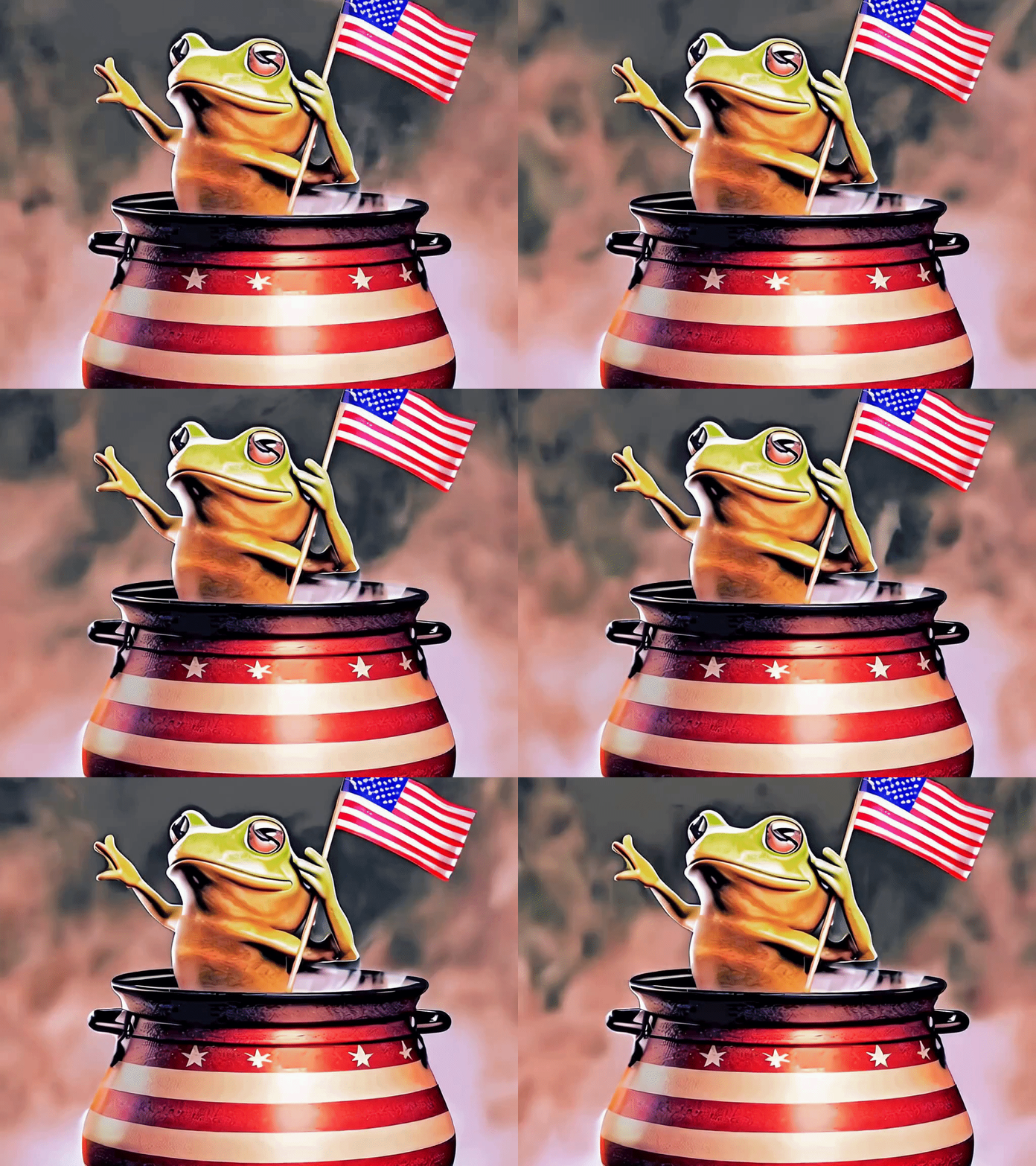
Until they finally understood, how “the frog was boiled alive”.
It was trapped in a regime of intolerance, unable to survive.
So beware, my fellow citizens, of christofascism in disguise,
for once it’s unleashed, bondage will be your surprise.
If freemen don’t defend liberty, and resist with all their might,
they’ll find themselves in a pot, slowly cooking, in the night.
By: ElRoyPoet © 2023
Poem Analysis: The poem presented serves as a powerful allegory for contemporary political discourse in the United States, specifically critiquing the actions and ideologies associated with the MAGA (Make America Great Again) movement. Through vivid imagery and sharp political commentary, the poem explores themes of authoritarianism, the erosion of democratic values, and the dangers of complacency in the face of tyranny. The poem’s critical elements, include the depiction of populism, the nature of the “monster,” and the urgent warning it conveys to citizens.
At the outset, the poem introduces a “populist monster” that embodies authoritarian tendencies. The phrase “once upon a time in America” invokes the traditional structure of a folktale, setting the stage for a cautionary tale about a modern political landscape. By describing the monster as having a “golden sway,” the poem suggests a deceptive allure, appealing to the masses while concealing underlying malevolence. The reference to the “swamp lands”—a term frequently used in political discourse—implies a corrupt environment where power struggles and ethical dilemmas thrive. The monster, representing the MAGA movement, takes on multiple facets, embodying bigotry and manipulation through its followers, capitalists, and power-hungry individuals.
The imagery of “cult followers” shows how some voters are seduced by ideologies that compromise democratic principles. The poem illustrates a stark contrast between the true believers, who serve as the monster’s “eyes and ears,” and the opportunists who exploit the situation for personal gain. This dynamic emphasizes the manipulation of public sentiment by those who prioritize their interests over the welfare of society. Furthermore, the mention of “nationalists” feigning patriotism highlights a disingenuous facade where love for country is twisted into a justification for oppressive actions. This manipulation is portrayed as a conspiracy against democracy, where the true essence of liberty is sacrificed for illusions of security.
As the poem progresses, it encapsulates the gradual descent into tyranny and oppression. The metaphor of a frog being boiled alive serves as a poignant illustration of how people can become desensitized to the encroachments on their freedoms. The gradual tightening of the monster’s grip reflects historical patterns in which authoritarian regimes consolidate power incrementally, often under the guise of necessary reforms or national security. The growing numbness among the populace signifies a troubling complacency that allows such regimes to flourish unchecked.
The poem further critiques the ideological compromises made by certain groups, particularly evangelical Christians and conservatives, who support authoritarian measures in the name of moral preservation. This willingness to sacrifice rights for perceived security demonstrates a profound misunderstanding of what true democracy entails. The poem warns that trading away individual liberties for a false sense of safety undermines the very foundations upon which democratic systems are built.
Finally, the concluding lines serve as a stark warning to citizens about the perils of inaction and complicity. The call to “beware of christofascism in disguise” suggests that oppressive ideologies can masquerade as benign or even beneficial. The final exhortation to defend liberty and resist tyranny emphasizes the critical role of civic engagement and vigilance in safeguarding democratic values. By framing inaction as a potential trap—where one finds themselves gradually “cooking in the night”—the poem leaves readers with an urgent sense of responsibility toward the democratic process.
In summary, the poem articulates a profound cautionary narrative about the rise of populist authoritarianism in America, using the metaphor of a monster to illustrate the complexities of contemporary political challenges. Through its exploration of manipulation, complacency, and the sacrifices made in the name of security, the poem compels readers to reflect on their roles as citizens in a democracy. It emphasizes the necessity of vigilance, engagement, and resistance in the face of authoritarian threats, encouraging a deeper understanding of the importance of preserving liberty and democratic integrity for future generations.
Why Trump is partnering with Christian Nationalists
Poem Prompt: Fascism is a political ideology that is often associated with authoritarianism, nationalism, and the suppression of individual rights. While it’s often seen as something that is imposed by a small group of people in power, the truth is that fascism requires a much broader base of supporters, who are also willing to tolerate it, for it to become a dominant force in society.
At the core of fascism are the true believers. These are the people who are deeply committed to the ideology and will do whatever it takes to promote it. They are often drawn to fascism because it promises power and a sense of superiority over other groups of people. They may be attracted to the strong, charismatic leaders who often head fascist movements and may even engage in extreme acts of violence to further the cause.
However, these cult followers alone are not enough to change the world. Fascism also requires opportunists, specifically crony capitalists, who are large corporations; who seek to eliminate competition from small businesses; and who hate unions. These opportunists are not motivated by ideology, but rather by their own personal interests. They often benefit greatly from a fascist regime that prioritizes the needs of big business over the needs of the people.
Another group that embraces fascism are those who see it as the lesser of two evils. Christian nationalists and conservatives may prefer fascism to democracy due to fears that a progressive-leaning government will result in more social or economic upheaval. They may also tolerate fascism so long as the populist politicians keep manipulating them into believing, that the government will not harm them or their children.
Perhaps the most important group for fascism to take root, is the public at large who feel intimidated and powerless to stand up to it. This group is often composed of people who have been disenfranchised by the current system and feel that fascism offers them a sense of belonging and safety. They may also feel intimidated by the propaganda and conspiracy theories, that threaten to disenfranchised them, even more so, if they don’t assimilate to the fascist movement.
Once a majority of the citizens allow themselves to be entrapped by authoritarians, the result is the same phenomenon that occurred in the allegory of “The Frog Who was Slowly Boiled Alive.” Just as the frog initially did not notice the gradual increase in water temperature and became acclimated to a new, dangerous environment, so too do people slowly become accustomed to fascism, because they are too entrenched in their dangerous police state and now it’s too late to turn back the hands of time.
In conclusion, while fascism may seem like something that can be imposed from above, the truth is that it requires a diverse group of people, for it to truly take root in the community. This includes true believers, opportunists, those who prefer it to alternatives, and the largest number of the public who feel too afraid and powerless to stand up to it. Ultimately, fascism thrives when the citizens in turn surrender all their civil liberties to the state.
Commentary: Everybody learns the hard way! The middle class is okay with the status quo—right now because they have the voting power. They also have the luxury of blaming the lower class for all the social ills that are afflicting America—claiming that the minorities have brought it upon themselves. The fact of the matter is that the lower class has negligible power, so even though they might complain or protest against being profiled as the dregs of society, it doesn’t really matter because they don’t have any political power. Besides, politicians don’t really care about them because they don’t have any economic power either. The demographic that has any real power to make a difference—right now, are the middle class. However, if they allow the government to become an autocracy, by voting in authoritarian representatives, they will get relegated to second-class citizens because they’re not elites. Even if they voice their complaints and engage in protests, it will be too late, because they will have no power left, just like the lower class has no power today. Case in point: any authoritarian regime on earth is proof that the state and the elites are first class, while the remaining population receives substandard treatment. This is the inevitable reality in a crony-capitalistic world.
“If our democracy dies, the reason won’t be that Americans were too apathetic to save it; it will be that they voted it out of existence.” By: H. Scott Butler
“The blame did not lay on evil men, for evil men always do evil things. The real damage is done by those millions who want to ‘survive.’ The honest men who just want to be left in peace. Those who don’t want their little lives disturbed by anything bigger than themselves. Those with no sides and no causes. Those who won’t take measure of their own strength, for fear of antagonizing their own weakness. Those who don’t like to make waves—or enemies. Those for whom freedom, honor, truth, and principles are only literature. Those who live small, mate small, die small. It’s the reductionist approach to life: if you keep it small, you’ll keep it under control. If you don’t make any noise, the bogeyman won’t find you. But it’s all an illusion, because they die too, those people who roll up their spirits into tiny little balls so as to be safe. Safe from what? Life is always on the edge of death; narrow streets lead to the same place as wide avenues, and a little candle burns itself out just like a flaming torch does. I choose my own way to burn.” By: Sophia Magdalena Scholl was a “woke” 21 year old German student and Antifa political activist, active within the White Rose non-violent resistance group in Nazi Germany.
“Being good is hard if you live under an authoritarian regime… Dictatorships elevate the nation and the leader as ultimate ends, while mere individuals have no inherent worth outside of their service to the state… Damir Marusic, an Atlantic Council senior fellow, recently wrote, ‘Putin is a wholly authentic Russian phenomenon, and the imperialist policy he’s pursuing in Ukraine is too.’ This is right, but only up to a point. We simply don’t know what individual Russians would choose, want—or become—if they had been socialized in a free, open democracy, rather than a dictatorship where fear is the air one breathes. Like everyone else, they are products of their environment. Authoritarianism corrupts society. Because punishment and reward are made into arbitrary instruments of the state, citizens have little incentive to pool resources, cooperate, or trust others. Survival is paramount, and survival requires putting one’s own interests above everything else, including traditional morality. In such a context, as the historian Timothy Snyder puts it, ‘life is nasty, brutish, and short; the pleasure of life is that it can be made nastier, more brutish, and shorter for others.’ This is the zero-sum mindset that transforms cruelty into virtue.
In short, authoritarianism twists the soul and distorts natural moral intuitions. In so doing, it renders its citizens—or, more precisely, its subjects—less morally culpable. To be fully morally culpable is to be free to choose between right and wrong. But that choice becomes much more difficult under conditions of dictatorship. Not everyone can be courageous and sacrifice life and livelihood to do the right thing.” Excerpt from Why the Russian People Go Along With Putin’s War
The warning signs before the Capitol riot
Psychological Factors Help Explain the January 6th Insurrection
Opinion | This complete psychological analysis reveals 14 key traits that explain Trump supporters
Western governments believe they can ban populism. They’re dangerously wrong
“I don’t write my post-apocalyptic stories, because that’s what I think our future will become. I write them, so that you’ll know what future to avoid.” By: Ray Bradbury
“Though liberty is established by law, we must be vigilant, for liberty to enslave us is always present under that same liberty. Our Constitution speaks of the ‘general welfare of the people’. Under that phrase all sorts of excesses can be employed by [authoritarian] tyrants—to make us bondsmen.” By: Marcus Tullius Cicero
“Everything in the State, nothing outside the State, nothing against the State.” By: Benito Mussolini
“The exercise of freedom will always create rebels, because that’s the origin of revolutions. We can’t have a sedentary society, just like we can’t have a perfect union. If you don’t want conflict in your family, church and state, you want fascism, and if that’s what you want, you don’t want democracy.” By: A. Freeman
Who do Politicians really serve?
 elroypoet.blog