
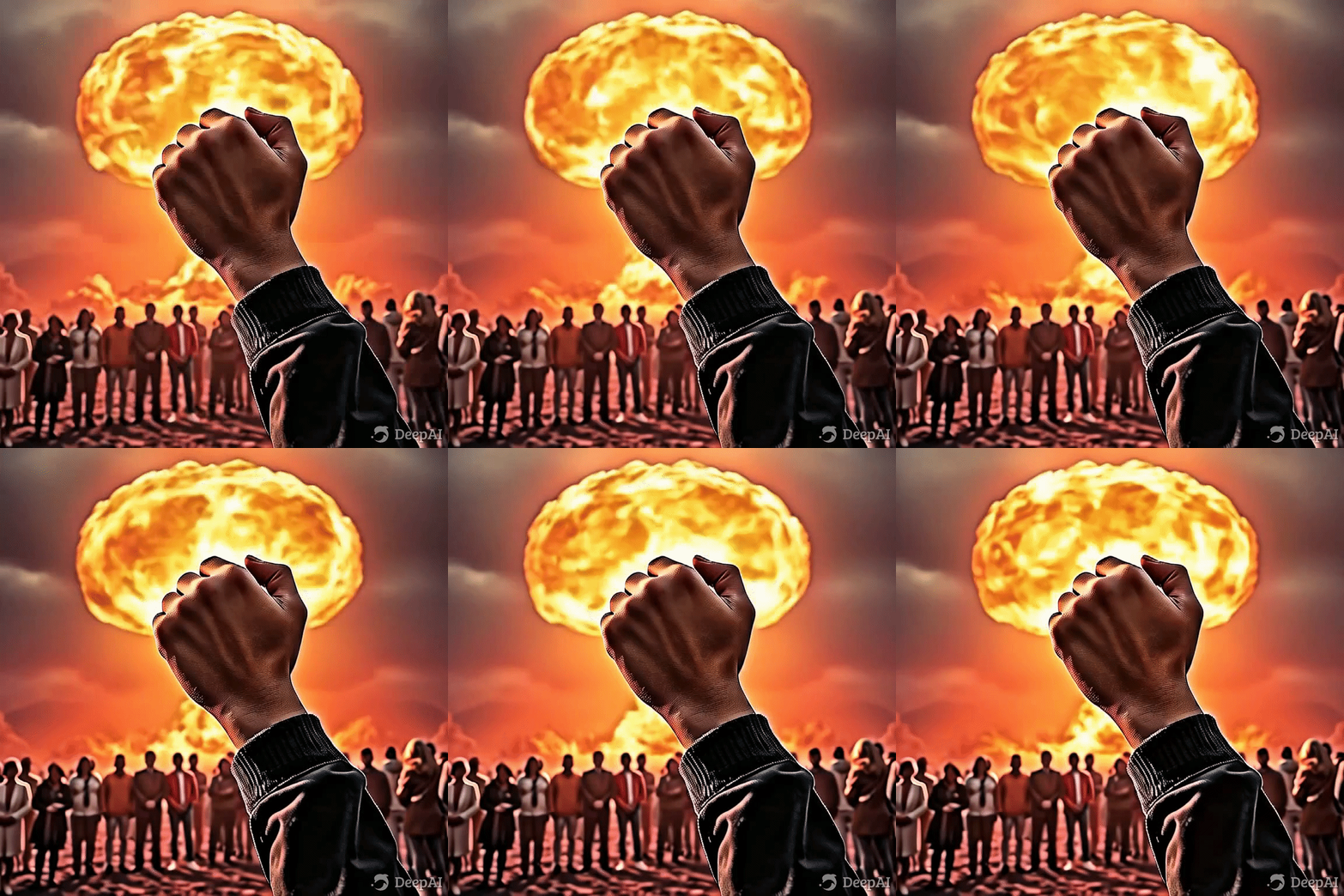
When leaders speak of shadows long,
And whisper words of “bad” and “wrong,”
They weave a tale of dark despair,
A menacing cloud lingering in the air.
Citizens trapped in a timeless loop,
Awaiting future’s unsettling bloop.
Hope falters amidst the dread,
As memories of better days are shred.
Why yearn for outcomes steeped in pain?
In suspenseful tales, we stake our claim.
With bated breath, we watch, we wait,
For a final solution or just savage fate.
Yet here I sit, amid the strife,
Tracking the toll on fragile life.
And as I tune in night by night,
The weight of betrayal dims the light.
Could I not shift, adjust my lens,
To seek the truth that democracy defends?
To forge a path where the fever breaks,
And communism no longer takes.
“Let’s rise! Let’s stand! Let’s overcome!”
With every heartbeat, we can become—
Defenders of liberty, voices strong.
In unity, we’ll prove the doomsday sayers wrong.
For in each free man, with each shared hand,
We shape the world; together we’ll stand.
Declaring now, through every rumor of war,
“We’ll get through this conflict; we’ll hold the bar.”
Edited by: ElRoyPoet, 2025
Trump ‘irreparably destroyed’ world order with Zelenskyy blowup
The Dangers of Indifference: A Historical Perspective on the Betrayal of Democracy
President Trump is constructing a narrative and justification for his betrayal of Ukraine and, by extension, his betrayal of America. By showing indifference to the Ukrainian people, he demonstrates an indifference to democracy itself. By downplaying Ukrainian sovereignty and failing to support a democratic ally under siege, Trump not only undermines Ukraine’s struggle against aggression but also indicates a dangerous apathy toward the principles of democracy that underpin the very identity and existence of the United States. This indifference is not merely a diplomatic oversight; it lays the groundwork for a more significant geopolitical imbalance.
“Three strikes”: Inside the Trump-Vance fury with Zelensky
The Historical Cycle of Indifference
Indifference in leadership can have dire consequences. Trump’s actions conveyed a disregard for international democratic principles when he incited an insurrection in Washington, D.C., following his loss in the 2020 election. This unprecedented assault on the U.S. Capitol, where supporters attempted to overturn the certified election results, starkly demonstrates how a leader’s betrayal can destabilize the bedrock of democracy.
“Any division of the West makes us all weaker, and benefits those who would like to see the decline of our civilization; not the decline of its power or influence, but the decline of the principles on which it was founded, first and foremost: freedom,” By: Italy’s Prime Minister Giorgia Meloni
When leaders of powerful democracies like the United States fail to defend democratic values, they embolden authoritarian regimes worldwide. Historical examples illustrate this phenomenon. One notable instance is the 1930s, when European democracies, primarily Britain and France, adopted a policy of appeasement toward Adolf Hitler’s Germany. The Munich Agreement of 1938, which permitted Hitler to annex parts of Czechoslovakia in exchange for a promise of peace, exemplifies this dangerous strategy. This policy not only failed to avert World War II but also encouraged further aggression from Hitler, ultimately leading to a devastating global conflict.
“You are not only fighting for your freedom but also for all of Europe’s,” By: Swedish Prime Minister Ulf Kristersson
Similarly, when President Obama drew a “red line” in Syria regarding the use of chemical weapons but failed to take action when that line was crossed, it sent a signal of weakness to Bashar al-Assad and others in the region. This perceived indifference eroded the credibility of American leadership and emboldened authoritarian figures, demonstrating how hesitation can have far-reaching consequences.
This complacency can embolden autocrats to pursue aggressive territorial expansions. Russia’s annexation of Crimea in 2014 under Vladimir Putin was, in part, a result of perceived Western indifference toward the sovereignty of democratic nations. Such indifference signals to ambitious autocrats that they can operate without significant repercussions, leading to a cycle of aggression that threatens global stability.
A critical examination of Trump’s foreign policy decisions, particularly his deal with the Taliban in Afghanistan, further illustrates the dangers of such indifference. When Trump negotiated an agreement with the Taliban that sidelined the democratically elected Afghan government, it had profound implications for Afghan democracy. The Taliban agreement not only excluded Afghan leaders from the negotiations but also suggested that the U.S. was prepared to abandon its commitments to its allies, fostering an erosion of confidence in American support. This act of sidelining a government committed to democratic governance exemplified a broader indifference to the fate of democracy in the region, reflecting a dangerous precedent for other democratic nations under threat.
The Implications of Indifference
As these historical lessons reveal, indifference to the struggles of democratic nations creates a dangerous precedent. Autocrats, sensing a vacuum of American leadership, feel empowered to act aggressively, believing they can invade smaller, sovereign nations without fear of repercussions. This is not merely speculation but a consistent pattern observed throughout history. For example, the Soviet Union’s expansion into Eastern Europe post-World War II was facilitated by a perceived lack of resolve from Western powers. The domino effect of Soviet aggression culminated in the Cold War, as neighboring countries fell under autocratic regimes, leading to decades of division and conflict.
World Leaders React to Zelensky and Trump’s Oval Office Showdown
If the betrayal becomes clearer, the American public may eventually recognize the gravity of their leaders’ inaction and its implications for democracy both at home and abroad. However, this realization may come too late. By the time the populace mobilizes to address the erosion of democratic principles, the damage may already be irreversible, leaving the United States in a position of weakness. This weakening threatens American diplomacy and jeopardizes the stability and strength of its allies.
‘There is no question this was a setup’: Susan Rice on Trump’s Oval Office ambush of Zelenskyy
The Cycle of Betrayal
Betrayal is not limited to inaction; it can also manifest in active collaboration with authoritarian regimes. Historical figures like Benedict Arnold illustrate how a single act of treachery can define a legacy. Arnold, an American general during the Revolutionary War, defected to the British side in 1780, believing that such a betrayal would secure his fortunes and influence. Instead, he became synonymous with treachery, forever labeled a traitor. The consequences of his actions not only impacted the military efforts against the British but also instilled profound distrust in American leadership.
“If Trump is willing to betray Ukraine, what prevents him from betraying other democracies in Europe as well? I believe he would, and I bet those European leaders perceive it too.” By: A. Freeman
When Trump downplays the consequences of supporting authoritarian leaders or fails to firmly oppose their actions, critics argue that he positions himself as a “modern-day Benedict Arnold”. His actions have caused discord in American trust and solidarity within the global democratic community. The saying “once a traitor, always a traitor” embodies the notion that betrayal, particularly by a leader, leads to lasting mistrust and division.
The Global Threat to Democracy
In a landscape where autocratic regimes adopt a binary stance towards the West—“if you are not with us, you are against us”—the United States risks becoming a primary target. Such rhetoric from totalitarian leaders signifies an intent to isolate and undermine the United States, framing it as an existential threat in the quest for global dominance. Leaders like Vladimir Putin and Xi Jinping perceive any sign of American retreat as an opportunity to expand their influence, mirroring how authoritarian regimes have historically exploited similar openings.
China’s slaughter-bots show WW3 would kill us all.
Neglecting the defense of democracy can yield staggering consequences. For instance, the disintegration of Yugoslavia in the 1990s, which led to brutal conflicts and ethnic cleansing, occurred partly due to the hesitance of European democracies and the United States to intervene decisively in the early stages of rising nationalism and autocratic governance. Such failures left a power vacuum that authoritarian leaders quickly filled, leading to humanitarian crises and regional destabilization.
In siding with Putin, Trump abandons U.S. position as ‘leader of the free world’
The failure to recognize and address threats to democracy results in disunity. The United Nations and its capacity to deter aggressive actions by authoritarian regimes have often been criticized as ineffective. The League of Nations, its predecessor, failed to prevent World War II despite its establishment aimed at maintaining peace. Thus, when democratic nations show weakness or division, it exacerbates the confidence of autocrats, allowing them to perceive a fractured world ripe for conquest.
The Need for Unity
Should this cycle continue unchecked, prospects for resistance will become increasingly bleak. As individual nations falter, larger military powers may exploit the disarray, overpowering the United States and its remaining allies. History shows that autocrats frequently miscalculate in their ambitions, leading to diplomatic blunders that could escalate into broader conflicts. For instance, Hitler’s invasion of the Soviet Union in 1941, driven by overconfidence, proved catastrophic for the Axis powers and ultimately shifted the course of World War II.
Historian analyzes devolving relations between U.S. and Ukraine after Oval Office spat
These dynamics hold significant implications for the present. If the current trajectory of indifference continues, the possibility of dire consequences, including large-scale military confrontations, looms larger. For example, in Eastern Europe, tensions have risen due to Russian aggression; any perceived weakness from the West could provoke World War III and challenges that spiral out of control.
Trump humiliated again on the world stage by British PM Starmer after France’s Macron
In conclusion, betrayal in leadership has significant historical repercussions and underscores the need for unwavering commitment to democratic principles. For the United States to maintain its role as the leader of the free world, it must never negotiate with terrorists, whether domestic or foreign, and must respond with ultimatums. If it turns a blind eye to terrorism by autocrats against democracies, the United States risks facing invasion. Leaders who betray their nations not only empower those who seek to undermine democracy but also compromise the stability of their economies and endanger the security of their citizens. Acknowledging the past is crucial to ensuring that history does not repeat itself. It is necessary for all democratic nations to present a united front—especially the leader of the free world—so that absolutely nobody gets the wrong impression.
Prompt:
When leaders say, “It will get worse before it gets better,” they doom all of society. When citizens hear this, they begin to anticipate that it has to get worse before it can get better. They start to feel as though they’re stuck in a time warp—while simultaneously hoping for the inevitable to arrive, so they can get on with their lives. Why would anyone want the worst-case scenario? The reason this phenomenon occurs is that people are intrigued and addicted to suspense and mystery movies. Their curiosity keeps them on the edge of their seats while waiting for resolution or catastrophe. I know—I’m guilty of this too, as every evening, I tune into the news to keep track of the body count. However, in retrospect, it doesn’t make sense to me. Shouldn’t I be doing my best to manage the crisis in order to reduce casualties? Therefore, I propose that we shift our perspective and embrace a more optimistic tone in our expressions. Instead, we should become prophets of encouragement and say, “We shall overcome, and we will get through this—together!”
Doomscrolling: Stop the scroll, protect your mental health
Poem Analysis:
The poem presents a compelling examination of leadership, despair, and the struggle for hope in the face of adversity. Through vivid imagery and a rhythmic progression, the speaker navigates themes of betrayal, democracy, and collective resilience. The poem serves as both a lamentation of current difficulties and a call to action, ultimately emphasizing the power of unity against oppressive forces.
Imagery of Despair and Betrayal
The opening stanza establishes a tone of foreboding, with leaders depicted as weavers of tales steeped in darkness. Phrases like “shadows long” and “dark despair” evoke a sense of dread, suggesting that the actions and words of those in power can cast long-lasting effects on society. The metaphor of “a menacing cloud lingering in the air” reinforces the idea that fear and uncertainty permeate the lives of citizens, creating an atmosphere of inescapable tension. This sense of helplessness is further amplified in the second stanza where citizens are described as “trapped in a timeless loop,” highlighting feelings of stagnation and resignation. The phrase “future’s unsettling bloop” represents the anxiety surrounding what lies ahead, blending themes of hope and despair in an unsettling juxtaposition.
The Cycle of Hope and Dread
As the poem unfolds, the struggle between fear and hope continues to shape the speaker’s perspective. The lines “Hope falters amidst the dread, / As memories of better days are shred” convey a deep sense of nostalgia intertwined with disappointment. The past becomes a painful contrast to the present, hinting at lost ideals that once defined a thriving democracy. The speaker’s yearning for liberation from the “outcomes steeped in pain” underscores a universal desire for positive change, reflecting the frustration many feel when confronted with inaction in times of crisis. The suspenseful atmosphere continues to build with the couplet, “For a final solution or just savage fate,” suggesting that the resolution to these struggles remains ambiguous and fraught with danger.
A Shift in Perspective
In the fourth stanza, the speaker acknowledges personal responsibility amid societal strife. Expressing a desire for clarity, the lines “Could I not shift, adjust my lens, / To seek the truth that democracy defends?” suggest an internal dialogue about perspective and awareness. This shift is particularly critical, as it highlights how individuals can reshape their understanding of their role in a democratic society. The call to “forge a path where the fever breaks, / And communism no longer takes” introduces an ideological conflict between democracy and communism, drawing attention to the need for vigilance and active participation in safeguarding freedom.
Call to Action and Unity
The penultimate stanza is a powerful rallying cry that encapsulates the poem’s central message of hope and perseverance. The refrain “Let’s rise! Let’s stand! Let’s overcome!” serves as a motivational crescendo, encouraging collective action among individuals united by shared values. The commitment to “defend liberty” and stand against “doomsday sayers” resonates with historical struggles against oppression, reinforcing the notion that unity is a potent tool against tyranny. The repeated use of inclusive language—“we can become”—invites readers to see themselves as part of a larger movement, thereby fostering a sense of community and purpose.
Ultimately, the poem encapsulates the complex interplay between despair and hope, illustrating that even amid strife and betrayal, the possibility for change remains within reach. The speaker’s journey from witnessing the darkness of leadership to embracing a collective resolve for democracy serves as a reminder of the resilience of the human spirit. It encourages readers to transform their anxieties into action, recognizing that through solidarity and shared vision, they can navigate the shadows and emerge into the light. In its powerful conclusion, the poem calls for endurance and unity, offering hope that conflict can be overcome and that a brighter future is possible. Through this exploration of leadership and citizen responsibility, the poem presents a timeless reminder of the importance of vigilance, connection, and hope in the face of challenges.
Why does it feel like the world is falling apart?
Commentary: Scholars who study conspiracy theories note that they flourish more easily when they tap into people’s preexisting prejudices, stereotypes or fears. They also propagate more readily—in what are perceived as times of upheaval and cultural change—when people feel like the Earth is moving under their feet.
“You can’t wait until life isn’t hard anymore, until you decide to be happy.” By: Jane Marczewski
“However, I feel anger and frustration at those who simply looked away. I’m now convinced by hard experience that much, if not most, evil is protected and prolonged by good people who choose not to see or hear. But we are each other’s keepers, and by God’s grace—as well as by the power of the internet, good journalism and truth tellers everywhere—it is harder and harder for us to look away. What we do once we face suffering and injustice, of course, remains to be seen.” Excerpt from We got here because too many good people put their head in the sand
“In every encounter, we either give life or we drain it; there is no neutral exchange.” By: Brennan Manning
“It’s about detachment, all the things in your life—you have to also be prepared to live without them.” By: Alexander Hurst
Further Reading:
The Psychological Toll of Catastrophe: Understanding Human Fascination with the Worst-Case Scenario
In modern society, the pervasive attitude that “it will get worse before it gets better” is often employed by leaders during crises. This phrase, while intended to prepare the public for impending difficulties, inadvertently instills a mindset that anticipates catastrophe. Psychological theories can help clarify why humans gravitate toward such narratives, often acting as if they are stuck in a time warp, trapped between dread and the desire for relief. As we explore this phenomenon, we must interrogate the underlying psychological mechanisms, including our fascination with suspense, the addiction to negative news, and the deep-seated human need for resolution.
The Anticipation of Catastrophe
To understand the psychological implications of this mindset, we must first acknowledge the concept of “doomscrolling”, a term that describes the compulsive consumption of negative news. Researchers like R. C. Leppin and J. G. Van Strien highlight that humans have a cognitive bias toward negativity, often due to evolutionary factors where awareness of potential threats could mean survival (Leppin & Van Strien, 2019). When leaders propagate narratives of catastrophe, citizens internalize these messages, facilitating a cycle of pessimism that can enhance feelings of helplessness. This conditioning is evident in how the public consumes news; by tracking negative developments, individuals feel a false sense of control, assuming that staying informed is equivalent to being prepared.
This mindset manifests as a psychological phenomenon termed “catastrophizing”, where individuals predict the worst possible outcomes. According to psychologist Aaron T. Beck, catastrophizing is often rooted in anxiety disorders and can lead to increased stress and fear (Beck, 1976). When leaders perpetuate the notion that difficulties are unavoidable, they activate these cognitive distortions within the populace, leading many to expect negative outcomes, thus reinforcing their fears.
The Suspense Element
Furthermore, the human fascination with suspense can be attributed to our innate curiosity. Psychologists have long studied how suspenseful narratives, particularly in films and media, grab our attention and manipulate our emotions (Zillmann & Bryant, 1985). Mystery and disaster movies often leave viewers on the edge of their seats, culminating in cathartic resolutions. This psychological engagement is inherently linked to the idea of anticipation, especially when tragedy is involved.
By tuning into distressing news reports daily, individuals effectively maintain a state of suspense about real-world tragedies, allowing them to psychologically engage with catastrophe despite the emotional toll it takes. The idea that “it has to get worse before it gets better” almost becomes a narrative that people willingly subscribe to, as it mirrors the familiar structure of a suspenseful story. Therefore, the sensation of helplessness and horror can paradoxically be comforting, as we cling to the hope of eventual resolution.
The Psychological Implications of Hope
Hope serves as an essential psychological resource during times of crisis. Researchers like Charles Snyder have established that hope fosters resilience and motivation (Snyder, 2002). However, the prevailing pessimism that emerges from catastrophe narratives can overshadow this vital emotion, causing individuals to exist in a state of suspended animation, where they await their inevitable fate.
Adopting a defensive stance in the face of catastrophe creates a culture of pessimism that can be detrimental. Instead of empowering societal resilience, such narratives promote a sense of futility. If individuals are conditioned to believe that suffering is a prerequisite for recovery, they may find it challenging to envision a future where hope prevails without undergoing pain. This mindset can lead to a cycle of despair that inhibits proactive engagement and community solidarity during times of difficulty.
A Shift in Perspective
In light of these insights, it is crucial to reconsider the language and narratives employed by leaders in times of crisis. Rather than perpetrating doom and gloom, we should emphasize optimistic perspectives that foster collective resilience. Promoting messages of encouragement, such as “We will get through this together,” can shift the prevailing narrative and inspire action rather than paralysis. By encouraging societal collaboration and resilience, we can combat the psychological damage caused by incessant negativity and foster a sense of agency among individuals.
The call to action is clear: let us change our viewpoint and foster a culture of hope and encouragement. With an optimistic tone, society can transform fear into determination, where the future is not just a waiting game for inevitable disaster, but a landscape paved with potential, collaboration, and shared success.
References:
Beck, A. T. (1976). Cognitive Therapy and the Emotional Disorders. New York: Penguin Books.
Leppin, R. & Van Strien, T. (2019). The Evolutionary Psychology of Negative Information. Journal of Evolutionary Psychology.
Snyder, C. R. (2002). Hope Theory: Rainbows in the Mind. Psychological Science, 13(2), 121–124.
Zillmann, D., & Bryant, J. (1985). Attraction to Life Threatening Events: Suspense and the Emotions in Horror Films. Communication Research, 12(3), 369–390.
 elroypoet.blog