
Take away the social programs,
I’ve never needed assistance or relief.
I’m self-sufficient, self-helped—
Dependence was never my belief.
Take away my civil rights,
It’s okay, I’ve always walked the line,
I’m free to speak, free to be me—
Without them, I’ll still be fine.
Take away my religious liberty,
Faith has always been my guide,
In quiet belief or spoken doubt,
My spirit will still abide.
Take away the American Dream,
I’ve made my life from work and grit,
No myth or promises needed here,
My reality built with my own wit.
Take away our democracy,
A liberal government that’s flawed,
But I’ll stand strong anyway,
My choice—my own applaud.
Edited by: ElRoyPoet, 2025
Analyzing the Illusion of Self-Made Prosperity: A Psychological and Sociopolitical Perspective
This satirical poem presents a stark critique of societal attitudes toward social programs, civil rights, environmental protections, and democratic institutions. Through a series of repeated refrains—”take away” statements—it underscores a troubling tendency among affluent individuals and communities to dismiss the very structures that have enabled their prosperity. Analyzing this poem through psychological and sociopolitical lenses reveals how psychological mechanisms and societal trends contribute to the degradation of democratic cohesion, especially when privileged groups scapegoat marginalized populations.
The Psychological Roots of Prosperity and Amnesia
From a psychological standpoint, the poem echoes phenomena such as the just-world hypothesis and cognitive dissonance. The just-world hypothesis suggests that individuals tend to believe that the world is inherently fair, leading those who are prosperous to rationalize their success as solely due to their own effort, dismissing structural factors like social programs or institutional support. The repeated assertion, “I’ve never used them anyway,” exemplifies this cognitive bias, implying that personal achievement is entirely self-made, disregarding the societal scaffolding that facilitated that success.
Cognitive dissonance also plays a role. When individuals enjoy prosperity, acknowledging the role of social programs or government institutions in their success may threaten their self-image or worldview. To reduce this discomfort, they deny or minimize the importance of these institutions, as reflected in the poem’s denial of reliance on social safety nets and civil rights. This denial fosters a sense of independence that is, in reality, built upon collective societal efforts.
The Societal Consequences of Forgetting Structural Foundations
When affluent communities—particularly those aligned with conservative, Republican, or white evangelical identities—detach their prosperity from societal support, they risk undermining the social fabric. The poem’s refrain about dismissing social programs and civil rights highlights how this detachment fosters entitlement and indifference towards the less fortunate. Psychological research indicates that when privileged groups perceive themselves as entirely self-sufficient, they are more prone to develop ingroup favoritism and outgroup hostility, viewing marginalized populations as threats or scapegoats.
This scapegoating is evident in the poem’s tone, where the “ingroup” blame the less fortunate, environmentalists, and social safety net recipients for societal problems. Such attitudes erode social cohesion, as they foster “us versus them” mentalities. When society’s cohesion weakens, democratic institutions—designed to promote inclusivity, representation, and mutual responsibility—become vulnerable to destabilization.
The Role of Democratic Institutions in Fostering the Middle Class
A crucial aspect often overlooked in discussions about prosperity and social mobility is the role that democratic institutions have played in cultivating and sustaining the middle class. These institutions—comprising fair electoral processes, labor protections, social safety nets, public education, and regulatory agencies—have historically served as the backbone of a society that enables upward mobility and shared prosperity.
Electoral Democracy and Policy Accountability
At the heart of democratic societies is the principle of political representation. Free and fair elections allow citizens to influence policy decisions that shape economic and social structures. When citizens participate actively, they can advocate for policies that promote economic opportunity, such as progressive taxation, education funding, and healthcare access. These policies, in turn, create an environment where the middle class can thrive, access quality education, and secure stable employment.
Labor Protections and Fair Wages
Democratic institutions have historically championed labor rights—minimum wage laws, safe working conditions, collective bargaining rights—which have been instrumental in enabling the middle class to gain economic security. For example, the New Deal policies in the United States during the 1930s expanded workers’ rights, leading to a burgeoning middle class by providing stable jobs with benefits.
Social Safety Nets and Economic Stability
Programs like Social Security, unemployment insurance, and public healthcare serve as buffers against economic downturns and unforeseen hardships. These safety nets prevent the middle class from falling into poverty during crises, fostering an environment of economic stability that encourages long-term investment in education, home-ownership, and entrepreneurship.
Public Education and Social Mobility
Perhaps most critically, democratic societies have prioritized public education systems that provide opportunities for all children, regardless of socioeconomic background. Education acts as a ladder, allowing individuals from diverse origins to acquire skills necessary for middle-class employment. Access to quality education reduces inequality and promotes social mobility, which is vital for the health of a democratic society.
Regulatory Frameworks and Economic Fairness
Regulatory agencies oversee markets to prevent monopolies, ensure fair competition, and protect consumers and workers. These institutions help maintain a level playing field, preventing the concentration of wealth and power that can undermine democratic ideals. By promoting economic fairness, democratic institutions create a more inclusive economy where the middle class can grow and sustain itself.
The Erosion of Democratic Cohesion and Its Consequences
When these institutions are weakened or dismantled—as the poem suggests—the foundation for a thriving middle class erodes. The result is a society where prosperity becomes more concentrated, and the social mobility that democratic policies once fostered diminishes. This erosion feeds into the poem’s narrative of entitlement and indifference among the affluent, who fail to recognize the collective effort that underpins their success.
Furthermore, when privileged communities scapegoat marginalized groups—blaming them for societal problems—they undermine the social cohesion necessary for a functioning democracy. Such attitudes foster division, breed resentment, and open the door for authoritarian tendencies to emerge. The poem’s closing lines—”Take it away, throw it all away, / The experiment was flawed anyway”—serve as a reflection of this nihilism, highlighting the fragility of democratic systems when social bonds are frayed.
In conclusion, this poem, through its satirical tone and repetitive structure, highlights the perilous disconnect between individual prosperity and societal support systems. Psychological mechanisms like the just-world hypothesis and cognitive dissonance contribute to this disconnect, enabling privileged groups to forget or dismiss the societal foundations of their success. When these communities scapegoat the less fortunate and deny the importance of social programs and protections, societal cohesion erodes, and democracy becomes vulnerable to destabilization.
Recognizing the historical and ongoing role of democratic institutions in fostering the growth of the middle class underscores their importance. These institutions—electoral processes, labor protections, social safety nets, public education, and fair regulation—are the engines that promote social mobility and shared prosperity. Safeguarding and strengthening them is essential for maintaining a resilient, inclusive democracy. Without them, the societal fabric weakens, and the risks of division, inequality, and authoritarianism increase. Ultimately, the poem reminds us that democracy’s success depends on collective acknowledgment and support of the societal structures that enable individual achievement.
Poem Prompt:
Take away my social programs,
I’ve never used them anyway.
Take away my civil rights,
I wasn’t using them anyway.
Take away my religious liberty,
I wasn’t believing it anyway.
Take away my public education,
Americans don’t get it anyway.
Take away my voting rights,
My voice didn’t count anyway.
Take away my public health,
We all self-medicate anyway.
Take away my Social Security,
Nobody cares about you anyway.
Take away the EPA, DOE, DOI, USDA—
I didn’t care about your safety anyway.
Take away my sovereignty,
I never had it anyway.
Take away the American dream,
I’m a self-made man anyway.
Take away my democracy,
It can’t help me anymore, anyway.
Take it away, throw it all away,
The experiment was flawed anyway.
Freedom and Anxiety – The Inner God vs. The Inner Worm
Commentary: In a perfect world, we wouldn’t have social programs, and you wouldn’t need Jesus. But the stark reality is that we live in a fallen world, filled with systemic injustice, inequality, and suffering. And here’s the truth: evangelicals need to stop bellyaching about supporting government social programs with their taxes because, last time I checked, they are also on the welfare rolls of the “Jesus Christ worldwide social institution”—not because they’ve earned salvation through good works, but because they rely on the grace of God through Jesus Christ to be saved. Ephesians 2:8-9 reminds us, “For it is by grace you have been saved, through faith—and this is not from yourselves, it is the gift of God—not by works, so that no one can boast.” Our salvation is a gift, not a product of our own efforts.
Yet, many evangelicals today fail to recognize that true faith in Christ calls us to live out that grace—manifested in compassion, justice, and mercy. Supporting social programs, caring for the poor, and standing against systemic injustice aren’t just political issues—they are biblical commands rooted in the love and grace we’ve received. Jesus Himself emphasized caring for the least of these: “Truly I tell you, whatever you did for one of the least of these brothers and sisters of mine, you did for me” (Matthew 25:40). The early church modeled this vividly—selling possessions to share with those in need (Acts 2:44-45). The core of the Gospel is love in action, justice in practice, humility in service.
Here’s the irony: evangelicals, relying on God’s grace for salvation, often criticize social programs that help the vulnerable—programs that reflect Christ’s love and justice. Supporting social safety nets isn’t a sign of weakness or lack of faith; it’s an authentic demonstration of the charity Jesus extends to evangelicals, too. When we turn away from helping those in need—whether through government support or church community action—we risk betraying the very Gospel we claim to uphold.
Consider the urgent issues facing the United States today: millions of people experiencing homelessness due to rising housing costs and a shortage of affordable housing; families torn apart by economic disparities, with income inequality reaching historic highs; immigrants fleeing from oppressive regimes, seeking safety and better opportunities in the U.S.; communities affected by increasingly severe climate-related disasters such as hurricanes, wildfires, and flooding; and millions of children living in poverty without reliable access to healthcare, quality education, or nutritious food, highlighting persistent systemic inequalities.
So I ask: do you want to be truly saved—by grace through faith—or do you want to remain just another drone in a MAGA authoritarian state, blindly echoing a political narrative that often contradicts the very faith you profess to believe? True faith calls us to action—to stand up for justice and to care for the vulnerable—and not to become complicit in propaganda and systems that perpetuate inequality and division.
Ultimately, genuine faith and moral integrity require you to evaluate where your loyalties truly lie and whether you’re willing to live out the radical love that Jesus modeled—love that transcends politics and human boundaries. We, who depend on the grace of God for salvation, are called to extend that same grace to others.
“The first thing to notice is the kind of personality that is attracted to Trump. The personality that does what Trump does is an authoritarian personality. Such individuals tend to follow rules, prefer to be led by authoritative figures, and like hierarchical and patriarchal structures—where a leader at the top issues all the orders, and everyone falls in line behind them. This resembles a more militaristic, top-down hierarchical system.
However, not all supporters of this style favor authoritarianism all the time. Authoritarianism isn’t a stable personality trait because no one can live their entire life like that. Everyone must engage in negotiation, collaboration, and back-and-forth interactions to live their lives. In other words, no authoritarian is authoritarian all the time. It’s not a fixed trait but rather a tendency that can be activated at different times. The key trigger for activating authoritarian traits is fear. When people feel fear, their need for hierarchy and order reemerges and takes hold—fear acts as the doorway that unlocks this personality trait.
So, what is it that brings about this fear among MAGA supporters and Trump followers? Trump is highly skilled at stoking fear. He started his campaign by accusing Mexican immigrants of being rapists and murderers, claiming they are invading our country and killing us all. Stoking fear has become his signature tactic; he’s very effective at it. During his inauguration, he spoke about a depiction of the world filled with threats—an atmosphere of fear, reinforced by Fox News and other conservative outlets—activating this authoritarian tendency in people.
Now, what do MAGA supporters fear the most? Interestingly, it’s not necessarily poverty or crime. Studies show that MAGA supporters are generally not less well-off than the average population. They’re not particularly disadvantaged overall. The unifying factor is a perceived loss of social status—what we can call status anxiety. This perceived threat to their social standing drives much of their fear.
The core of MAGA, of course, is white males. They used to hold a dominant position within the social hierarchy. As women gain more empowerment and immigrants become more assertive or take on leadership roles, these men feel that their automatic right to social superiority is being challenged. This creates a social status anxiety—a fear that their traditional dominance is slipping away. While not all white people feel this way, many MAGA supporters do come from this base.
This anxiety isn’t limited to white males; it can also be present in minorities and women. For example, many white women voted for Trump in the last election, partly because they, too, perceive a threat to their social status—particularly if they see minority women gaining political power or other groups advancing. When people feel their status as the dominant group is being undermined, they experience a form of cultural dethronement.
So, what does this all mean? Essentially, MAGA supporters are driven by a desire to restore what they perceive as their lost dominance. When they talk about “Making America Great Again,” they mean restoring their subgroup’s former status of power. This doesn’t necessarily mean improving their quality of life or economic situation. Instead, it’s about pushing others down—those they see as threats—so they can feel superior again.
This desire to push others down provides a sense of relief from their social status anxiety. They revel in the idea of seeing others, such as immigrants, women, or marginalized groups, being pushed aside. This acts as a form of resentment—marinating in fury at being overtaken or replaced. It’s like a burning coal in their chest—something they can’t tolerate or hold onto peacefully.
A recent tweet by an ABC journalist, which was later taken down, captured this dynamic well. He said that Steven Miller isn’t in his position because he’s particularly smart but because he embodies bile—an intense hatred and resentment. This statement resonates with how others describe him as someone filled with hatred for immigrants and marginalized groups. Steven Miller’s role, and similar figures, reflect the resentment and hostility that underpin much of the MAGA movement.
Many former Republican operatives, like Rick Wilson, have spoken about how figures like Miller are fueled by this bile—more than intellect—focused on hatred of others. This resentment is what drives the movement. They are marinated in it, and their only “medicine” is to see those they fear being pushed down. That’s why they often support policies of cruelty and show off their harshness—Trump’s executive orders frequently demonstrate this.
When Trump feels threatened—whether by legal issues or political challenges—his supporters often feel similarly threatened because they see themselves merged with him. They feel victimized when he is attacked, and their support increases when he is convicted or faces legal repercussions. They identify with him as someone under attack, and this deepens their loyalty.
This connection isn’t limited to white supporters. Minorities, too, can experience status anxiety. For example, in recent elections, many Latino and Black men voted for Trump—often because they saw themselves as holding a position of relative superiority within their communities, especially over women. As women gain more power, some men feel their social status is threatened. White women, too, largely supported Trump in 2016, reflecting this shared status anxiety.
Basically, what unites these groups is a fear of losing social dominance—an anxiety that triggers the authoritarian tendencies within them. This leads them to follow Trump, the “piper,” to wherever he leads, even if that means dismantling democracy. They are willing to accept authoritarianism, cruelty, and the erosion of democratic norms because their primary concern is restoring their perceived superiority.
[The fallacy in this thinking is that many Latino and Black voters believed supporting Trump would restore their social status, but they overlook that their opportunities depend on democracy and the protections of the Constitution. When power shifts to authoritarian leaders, these rights are at risk, and social hierarchies become based on race and privilege, with non-white citizens relegated to second-class status.
Ironically, wannabe authoritarian leaders within the Republican Party have tricked Latino and Black voters into believing that, even if they forfeit democracy, they will still retain their civil rights. Our Constitution is the only thing that guarantees these privileges. When democracy is replaced with autocracy, inevitably the Constitution soon follows suit.]
It’s essential to recognize that this isn’t just about Trump trying to grab power; it’s about a significant segment of America’s population—willing and eager to dismantle democracy itself. This presents an enormous existential threat—not just from Trump, but from this widespread movement and psychology.
To combat this, we need systemic change—deepening and spreading democratic engagement beyond just voting every four years. We must foster a participatory, deliberative process that involves everyone continuously. Understanding the psychology behind the MAGA movement—the resentment rooted in being usurped—is crucial. Only then can we take meaningful steps toward healing.
Writing people off as psychopaths, greed-driven, or narcissistic isn’t enough. We need deeper understanding and community support—especially during this deeply traumatic period in history. We must support each other and share our struggles.
Remember, much of the current infrastructure—social media platforms and information channels—is controlled by a few oligarchs in collusion with authoritarians who could shut down voices like mine at any moment. We must stay connected and organized for the future of our children.” Excerpts from: What Makes Trump & MAGA So Cruel? A Psychiatrist Explains
Photo Caption:
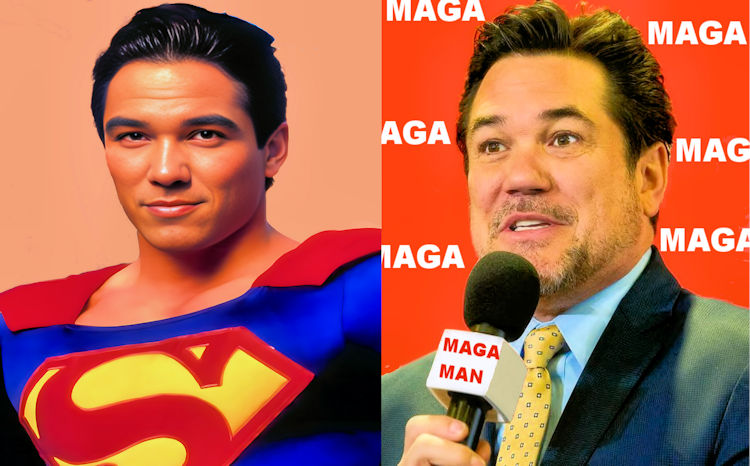
Dean Cain aka “superman” actor could use his platform to promote ‘Truth, Justice and the American Way’, but instead he chooses to promote ‘fear, bigotry and the MAGA way’.
I believe I can fly.
I believe I can touch the sky.
Because—
I’m better than the immigrants
That’s why…
“It does not matter how well the Bible, or the Constitution was written: if those aspirations are not animated by the spirit that dwells in your heart.” By: ElRoyPoet
“If our democracy dies, the reason won’t be that Americans were too apathetic to save it; it will be that they voted it out of existence.” By: H. Scott Butler
“In order for a government to become a fascist regime, the church must allow itself to be swallowed by the state. In order for a government to remain democratic, the state must be kept separated from the church—so that it isn’t tempted to swallow ‘freedom of religion’.” By: A. Freeman
“Though liberty is established by law, we must be vigilant, for liberty to enslave us is always present under that same liberty. Our Constitution speaks of the ‘general welfare of the people’. Under that phrase all sorts of excesses can be employed by [authoritarian] tyrants—to make us bondmen.” By: Marcus Tullius Cicero
“Ignorance breeds fear. We fear those things we don’t understand. If we don’t put a lid on that fear and keep that fear in check, that fear in turn will breed hatred because we hate those things that frighten us. “If we don’t keep that hatred in check, that hatred in turn will breed destruction.” By: Daryl Davis
“The inhumanity of bigots and tyrants is that they will never experience guilt or regret, about their desires superseding the needs of those whom they control or hold power over. They are not capable of feeling empathy or compassion for inferior beings.” By: A. Freeman
“Anger and intolerance are the twin enemies of correct understanding.” By: Mahatma Gandhi
 elroypoet.blog
RE: “Writing people off as psychopaths, greed-driven, or narcissistic isn’t enough. We need deeper understanding and community support…. We must support each other and share our struggles.”
No, this isn’t what we need FIRST AND FOREMOST. A real deeper understanding is what we needs. It involves THIS…
By FAR the most vital urgent and DEEP understanding everyone needs to gain is that a mafia network of manipulating PSYCHOPATHS are, and always have been, governing big businesses and institutions (eg official medicine, big academia, big tech, big banks, big religions), nations and the world — the evidence is very solid in front of everyone’s “awake” nose: see “The 2 Married Pink Elephants In The Historical Room”
“When a well-packaged web of lies has been sold gradually to the masses over generations, the truth will seem utterly preposterous and its speaker, a raving lunatic.” — Dresden James
And psychopaths are typically NOT how Hollywood propaganda movies (or the Wikipedia/WebMD propaganda outlets) have showcased them. And therefore one better RE-learns what a psychopath REALLY is. One’ll then know why they exploit/harm everyone, why they want to control everyone and have been creating a new world order/global dictatorship, and many other formerly puzzling things will become very clear.
The official narrative is… “trust official science” and “trust the authorities” but as with these and all other “official narratives” they want you to trust and believe …
“We’ll know our Disinformation Program is complete when everything the American public [and global public] believes is false.” —William Casey, a former CIA director=a leading psychopathic criminal of the genocidal US regime
“Repeating what others say and think is not being awake. Humans have been sold many lies…God, Jesus, Democracy, Money, Education, etc. If you haven’t explored your beliefs about life, then you are not awake.” — E.J. Doyle, songwriter
But global rulership by psychopaths is only ONE part of the equation that makes up the destructive human condition as the cited article above explains.
Without a proper understanding, and full acknowledgment, of the true WHOLE problem and reality, no real constructive LASTING change is possible for humanity.
And if anyone does NOT acknowledge, recognize, and face (either wittingly or unwittingly) the WHOLE truth THEY are helping to prevent this from happening. And so they are “part of the problem” and not part of the solution.
LikeLike