
I should’ve never dived headfirst
into this cesspool of hate and deception.
I should’ve probed the water first.
I haven’t been able to change—
not even one of those “MAGA” ideologies.
I used to be content in my own space—
writing my “First Amendment” rhymes.
But when I was confronted by those injustices,
I felt obliged to protest with political poetry.
Trying to turn the tide
in the fearful hearts of men—
but the waves keep crashing in.
Oh, how my eyes burn from the smoke—
when will the republicans learn—there’s fallout
when you can’t defend your fellow man?
By: ElRoyPoet © 2021
Claim: “We don’t believe in political violence, but we do believe in civility.” By: JD Vance
Question: “But is it civil to provoke political violence on political enemies, via cancel culture?” By: A. Freeman
Answer: Provoking violence through cancel culture raises serious concerns about civility, safety, and respect for human rights, especially when it incites or encourages harm or retaliation toward individuals or groups with differing political views. While social accountability through public criticism can be legitimate, it becomes problematic if it leads to harassment, violence, or retaliatory actions, undermining principles of non-violence and civil discourse vital to social cohesion.
Legally, the First Amendment protects free speech, including controversial opinions, but it does not shield speech that incites imminent lawless action or violence. Therefore, provoking or encouraging violence or retaliation—whether directly or indirectly—can cross legal and ethical boundaries, rendering such behavior both uncivil and unethical. Promoting respectful dialogue and peaceful disagreement aligns better with the ideals of a democratic society, emphasizing that responsible communication respecting differing viewpoints is essential, while recognizing that free speech does not endorse harmful or retaliatory expressions.
There once was a democracy in doubt,
Where dialogue kept progress shut out,
But the debates didn’t sway,
They just led to more delay,
While authoritarians ran the freedom clock out.
For too long, I believed that engaging in civil debate with MAGA cult followers was the path to understanding and change. I thought that by listening patiently and discussing calmly, I could bridge the widening gap dividing us. But over time, I’ve realized this approach is not only ineffective—it’s dangerous. We are, in essence, talking ourselves off a cliff.
History teaches us that when authoritarian movements gain momentum, dialogue without decisive action can accelerate the descent into tyranny. Look at the rise of fascist regimes in the early 20th century. Leaders like Hitler and Mussolini exploited the veneer of rational debate, lulling opponents into a false sense of security, fostering complacency and cynicism within the populace. Their tactic was to appear reasonable while consolidating power—precisely what many conservatives now claim about their own approach. But history warns us: appeasement and endless debate can be tools to delay necessary resistance, allowing authoritarian tendencies to take root. This was not a sudden, violent takeover but a gradual erosion of democratic norms. The Weimar Republic, a fragile democracy in Germany, suffered from this dynamic. Apathy and disillusionment with politics, fueled by economic hardship and extremist rhetoric, allowed the Nazi party to gain power incrementally. Citizens, weary of political gridlock and convinced that the system was incapable of addressing their concerns, surrendered to promises of strong leadership and national revival.
The Weimar Republic provides a stark example. Constant political infighting, economic instability, and social unrest created fertile ground for extremism. Public cynicism grew alongside a sense of powerlessness. This atmosphere was exploited by the Nazis, who promised order, stability, and national pride. The failure of democratic institutions to respond effectively to crises, combined with citizen passivity, created a vacuum the Nazis filled.
Further afield, the rise of the Khmer Rouge in Cambodia demonstrates a similar pattern. Decades of instability and social upheaval, culminating in widespread cynicism about the government, created a context where the Khmer Rouge’s radical promises of a utopian society resonated with a desperate population. Deep mistrust of the political elite contributed to radicalization, ultimately overwhelming the democratic process.
Though vastly different in context, these examples underscore a crucial truth: complacency and cynicism, when coupled with a perception that democratic institutions cannot address citizens’ concerns, open the door to authoritarianism. The path to democracy’s preservation involves active defense of its principles and institutions, not endless dialogue. Ignoring these dangers or believing reason alone can prevail is a perilous gamble with our freedoms.
Psychologically, this dynamic stems from “confirmation bias,” where individuals favor information that confirms their existing beliefs. Many MAGA followers are deeply brainwashed—relying on distorted facts and narratives that reinforce loyalty. They refuse to remove the blinders because confronting the possibility of being wrong causes cognitive dissonance. Psychologist Leon Festinger’s work explains that when core beliefs are challenged, people tend to double down rather than reconsider—especially when their beliefs are reinforced by community and identity.
Meanwhile, we seek validation through civil conversations, believing reason and civility will sway minds. But history and psychology show this is often futile when the other side is committed to different goals. Many followers are rooted in groupthink and fear, making them resistant to change. We are, in effect, rushing toward the cliff’s edge—faster than before—while MAGA followers virtue signal by claiming to be more reasonable because they “welcome debate.” But what does that matter if, in the process, our democracy becomes ineffectual?
The truth is, their “reasonableness” is a facade. Their willingness to debate is a mean-spirited tactic to buy time, stall progress, and underhandedly “own the libs”—to outlast us politically. Meanwhile, democratic norms continue to erode. We are witnessing a dangerous slide from democratic principles into autocratic rule. The longer we indulge in endless conversations without action, the closer we get to the precipice.
Most tragically, MAGA followers are caught in a cycle of brainwashing, unwilling to see that they are in the same boat as liberals—both victims of manipulation and misinformation. Their refusal to recognize this undermines the very democracy they claim to support.
The current political climate—with echo chambers and disinformation—bears a chilling resemblance. Rational discourse is being undermined, replaced by tribalism and power struggles. Engaging in polite conversation, while seemingly harmless, risks legitimizing harmful ideologies and providing cover for those seeking to dismantle our freedoms. Some actors are not interested in constructive dialogue; their goal is to sow discord and seize control. A new approach is necessary. We must confront lies, challenge narratives, and defend democratic processes under attack. This demands decisive action, resisting the lure of endless debate, and standing firm for truth and freedom.
We must accept that some battles are not won through dialogue alone. Progress requires concrete steps—voting, resisting authoritarian tendencies, and defending democratic institutions. We cannot keep talking ourselves off the edge while the cliff looms beneath us. It’s time to recognize when debate becomes a delaying tactic and focus on urgent efforts to preserve our democracy before it’s too late.
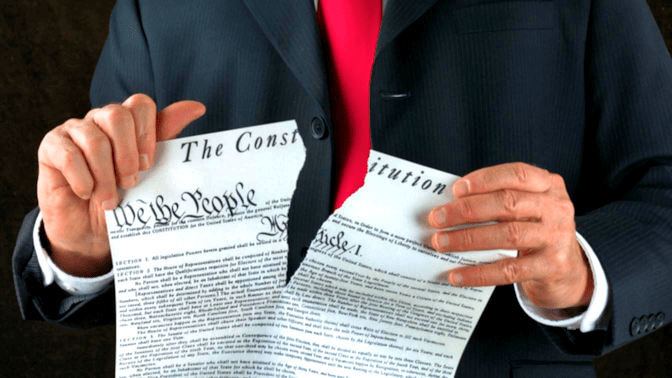
The First Amendment is the keystone of the Constitution, upholding our democracy. Don’t be deceived into believing that you don’t need the First Amendment. If you willingly surrender your rights, what makes you think the government can be trusted—not to trick you—into giving up your Second Amendment rights as well? Even if you resist, it may be too late, because you’ve already forfeited your First Amendment—your protections of freedom of speech and assembly. The forfeiture of our First Amendment, whether through coercion, deceit, or choice, is the greatest threat to our democracy.
“When you take care of your first priority, everything else will be okay,” or “When you do first things—first, everything else will fall into place. However, if you do second things—first, everything else will fall apart.” Our Founders were aware of how subtle government tyranny can be. We owe them a debt of gratitude for amending the Constitution with the Bill of Rights.
In conclusion, the Second Amendment primarily serves as a safeguard to ensure our First Amendment protections are defended. But don’t be deceived—when the Second Amendment was enacted, it was intended as a deterrent against government tyranny. In December 1791, it was probably feasible for a militia of colonists with muskets to challenge the standing army. However, in our current state, a militia of armed citizens could never overthrow the government because the armed forces possess weapons of mass destruction and control the military logistics network. Essentially, if our First Amendment falls, Second Amendment advocates won’t be able to defend themselves. As a consequence, whoever orchestrates a military coup will eventually rule over the survivors.

MAGA Republicans are wicked; they want to take away our freedom of speech, freedom of the press, freedom to peacefully assemble, and the right to petition the government for redress. Evangelicals are worse—they are “pure evil”. They have made a pact with the devil to replace freedom of religion with one exclusive state church and to ban all other religions in America.
The Collapse of Freedom of Religion: A Shift from Faith to Authoritarianism
The evangelical church, at its core, is built upon faith in Jesus Christ as Lord and Savior. However, when it shifts its focus from spiritual faith to seeking influence through government power, it risks internal division and spiritual ruin. This shift often manifests in advocating for authoritarianism in government, attempting to establish a de facto state religion, and undermining foundational freedoms such as the First Amendment’s guarantee of religious liberty.
Matthew 12:25-30 emphasizes a vital principle: a government divided against itself cannot stand. Jesus states that internal conflict weakens any organization, whether a kingdom, city, household, or spiritual movement. When the church aligns itself more with political power and seeks to impose a particular religious worldview through government, it creates factions within its own ranks and beyond. The desire to establish a state religion—where faith becomes subordinate to political authority—contradicts the very essence of Christian liberty and the biblical call to serve Christ alone. Such efforts threaten to dismantle the First Amendment’s protection of religious freedom, replacing individual conscience with government enforcement.
Furthermore, Jesus describes a “strong man” whose possessions are being plundered only after he is first tied up. In spiritual terms, the “strong man” represents Satan’s domain, which Christ came to defeat through spiritual authority. When the church turns to wielding government power—pursuing political influence and attempting to control societal institutions—it risks trying to do the work of Christ through human authority. This approach may resemble attempting to “tie up” the spiritual conflict with political force, but Jesus warns that true victory comes through reliance on the Spirit, not coercion.
Jesus states that whoever is not with Him is against Him, and those who do not gather with Him scatter. When the church becomes entangled in political battles—especially those advocating authoritarianism and the suppression of religious pluralism—it risks dividing itself from the core message of Christ’s love and freedom. Instead of gathering people into the unity of faith, it fosters division, strife, and even the suppression of differing religious voices, ultimately scattering its influence and credibility.
In summary, the evangelical church’s pursuit of political power—particularly through authoritarianism, the desire to establish a state religion, and the undermining of constitutional protections like the First Amendment—threatens to compromise its spiritual integrity. As Jesus warns, a kingdom divided cannot stand. When faith in Jesus is supplanted by the pursuit of worldly power and control, the church becomes vulnerable to internal strife and spiritual collapse. True strength lies in unity with Christ and reliance on His Spirit, not in coercive political influence. Without this foundation, the church risks falling, having forsaken its divine calling for the fleeting power of worldly dominance.
Hollywood Notables and Politicians React to ‘Jimmy Kimmel Live!’ Suspension: “This Isn’t Right”
‘Dangerous as hell’: Cruz slams FCC chair’s ABC threats
Why did alleged assassin target Kirk? Evidence paints complicated picture
What’s different about the Charlie Kirk firings
Religious Americans are divided over Charlie Kirk.
Country Music Star Zach Bryan Speaks Out After Right-Wing Anger Over Anti-ICE Lyrics
Definition: A common debate surrounding cancel culture questions whether the practice of shaming those who have committed a controversial action holds them accountable or unjustly punishes them. A 2020 Pew Research Center survey found that Democrats were more likely to consider the practice of canceling as holding people accountable. Republicans, on the other hand, tend to believe that canceling people is generally unwarranted. Conservatives further argue that cancel culture is a form of censorship meant to discourage open debate, which they view as a threat to free speech. Political commentators, however, have pointed out that many conservative politicians have drafted legislation that prohibits LGBTQ+ symbols in classrooms and that many oppose expressions of protest that do not fit within a conservative agenda. Although cancel culture does not directly violate the First Amendment, it does affect freedom of expression, especially if it inhibits people from voicing their opinions for fear of being canceled.
Many debates about cancel culture center on whether those who are canceled deserve to face real consequences, such as being fired from their jobs, and whether it makes sense to dismiss someone outright for seemingly honest mistakes. A 2022 episode of the RadioEd podcast out of the University of Denver raised the question “How do you know when someone—a public figure or a regular person—has been punished enough? Or is there no limit to how extreme the societal alienation can be?”—Britannica
Op-Ed: If your mind is already made up, your emotions will defend your position to the point that others will accuse you of being stubborn or a lunatic, because you are perceived to be set in your ways.
The human brain resists change because once it has figured out how to process information into a narrative that makes sense, it considers the matter solved. The brain optimizes its processes by not revisiting solved problems to focus on new challenges — forming habits and mannerisms that allow us to complete routine tasks more efficiently with less conscious thought.
The brain sets up patterns and routines to conserve mental energy, and promote efficiency and adaptability, ultimately reducing cognitive load and decision fatigue, decreasing stress, and improving clarity. These automatic behaviors improve productivity, save time, provide structure, and stability in our lives.
After the efficient brain has figured something out, it doesn’t need to reanalyze it ever again; it is no longer a question but an answer. The brain does not have to revisit a previously answered question because it considers the case closed and categorizes it as an answer rather than a question. Answers cannot revert to questions; otherwise, the mind would become confused.
Introspectively, this scientific evidence implicates Christians when they backslide into “Christian nationalist” tendencies. When they claim that “Jesus is the Answer for the world, today,” does that mean they have already made a decision for Christ? Or are they still trying to make up their minds as to whether Jesus is the answer to their question of faith, or do they face lingering uncertainty due to the persistence of idolatry?
The adherence to “prosperity religion” reinforces a distorted view of Christianity that centers on material gain and personal success. This narrow focus on prosperity can act as an idol itself, diverting attention and dedication away from the broader teachings of Christ, such as compassion, unity, and social justice.
Scientific evidence suggests that evangelicals with Christian nationalist tendencies tend to resist new information and struggle to critically evaluate their beliefs. This resistance to change extends beyond religious spheres and has implications for society, leading to divisions and an inability to address complex issues effectively.
In order to combat this narrow-mindedness and promote a more balanced approach, Christians must maintain an open mind and engage in ongoing self-reflection. They should be willing to re-examine their beliefs in light of new information and different perspectives, avoiding the pitfalls of dogmatism.
Christians should actively seek out and listen to the voices of those with contrasting opinions on social, political, and theological issues. By actively seeking out and listening to a range of viewpoints, they can foster empathy, understanding, and cooperation, which in turn helps to bridge divides.
In conclusion, professing Christians must be cautious of falling into the trap of Christian nationalism because it will inhibit personal growth and promote a narrow and intolerant worldview. By maintaining an open mind and critically examining their beliefs Christians can better navigate the complexities of faith, share the gospel and respond to the challenges facing society in a more inclusive and compassionate manner.
On January 27, 1838, Abraham Lincoln addressed the Young Men’s Lyceum in Springfield, Illinois: “At what point then is the approach of danger to be expected? I answer, if it ever reach us, it must spring up among us. It cannot come from abroad. If destruction be our lot, we must ourselves be its author and finisher. As a nation of freemen, we must live through all time, or die by suicide.” Christian McWhirter, Historian at Abraham Lincoln Presidential Library and Museum has said that Lincoln’s main subject in this speech, which is generally considered to be Lincoln’s first great speech, was ‘The Perpetuation of our Political Institutions’: “By that, he meant he was concerned about a recent rise in extra-legal, mob violence in America. […] Lincoln believed America’s young democratic institutions were fragile […] and advised his audience that their political concerns could only be properly addressed through the law. Although mob action may seem expedient, it ultimately damages the rule of law, and with it the Constitution, and with that democracy itself. Thus, the reference to national “suicide.” Excerpts from Lyceum Address
“The exercise of freedom will always create rebels, because that’s the origin of revolutions. We can’t have a sedentary society, just like we can’t have a perfect union. If you don’t want conflict in your family, church and state, you want fascism, and if that’s what you want, you don’t want democracy.” By: A. Freeman
“We must choose to live in this world and to project our own meaning and value onto it in order to make sense of it. This means that people are free and burdened by it, since with freedom there is a terrible, even debilitating, responsibility to live and act authentically. Every human is free, but freedom itself is relative; one must embrace limits, moderation, ‘calculated risk’; absolutes are anti-human. ‘I choose freedom. For even if justice is not realized, freedom maintains the power of protest against injustice and keeps communication open.’” [Is this is what happens when polarization takes hold of society?] “If you are thoroughly committed to an idea, are you compelled to kill for it? What price for justice? What price for freedom? Absolutism, and the impossible idealism it inspires, is a dangerous path forward.” Excerpts from How Camus and Sartre split up over the question of how to be free
Commentary: If you let MAGA Republicans gain the upper hand, we will all become bondmen, and democracy will fail. We have no choice but to ensure that freedom prevails. Don’t believe their lies about having it both ways. You can’t support liberal democracy while selling your capitalist soul to autocracy. It’s a trick designed to weaken your conviction, destabilize your firm foundation, and make you overconfident, leading you to believe you won’t be affected by the slippery slope toward autocracy. Supporting autocracy undermines democracy—why is that so hard to understand? Communists, socialists, fascists, and Marxists often embrace one another because they don’t feel threatened by each other. They create the illusion of “honor among thieves.” The only way to save humanity is for truth and democracy to triumph over deception and autocracy. “Injustice anywhere is a threat to justice everywhere,” and it’s coming to a theater near you.
Jesus came to earth to separate the sheep from the goats (Matthew 25:32). He did not come to bring peace, but a sword. He came to turn a man against his father, against his brother, a woman against her mother, against her sister, because no one can stand in the way of the worship of God. These are the consequences of his intervention. (Matthew 10:32–42). However, when Donald Trump became president, he also turned everyone against everybody else, and divided the country in order to conquer the minds of the evangelicals. Like other cult leaders before him, he became a fake savior for the Christian nationalists who were seeking an idol to worship (Exodus 32:1–9). So the real question is, who do you claim as your savior— Jesus who died for your sins, or a cult leader who deceives you into forfeiting your liberty for his sins? (Joshua 24:14–28). By the way, if you choose a populist leader or another authoritarian, you are stuck with them forever because once you relinquish your freedom, you will never be able to vote them out, even if you change your mind later (Matthew 25:31–46).
“In order for a government to become a christo-fascist regime, the church must allow itself to be swallowed by the state. In order for a government to remain democratic, the state must be kept separated from the church—so that they’re not tempted to swallow each other.” By: A. Freeman
“To the working man religion is true, because he needs hope in order to endure his lot in life; to the scholar, false because he’s arrogant; and to the authoritarian useful, so that he can control the poor man and shame the academic.” By: B. Bondsman
“The safest road to hell is the gradual one — the gentle slope, soft underfoot, without sudden turnings, without milestones, without signposts.” By: C. S. Lewis
“Those who would give up essential liberty, to purchase a little temporary safety, deserve neither liberty nor safety.” By: Benjamin Franklin
“If you ban mask mandates, outlaw abortions, dictate what educators can teach in schools [censor speech], and stop people from voting, you’re not the party of “limited government.” By: Robert Reich
“It is we who nourish the ‘Soul Of The World’, and the world we live in will be either better or worse, depending on whether we become better or worse.” By: Paulo Coelho
“If our democracy dies, the reason won’t be that Americans were too apathetic to save it; it will be that they voted it out of existence.” By: H. Scott Butler
“Though liberty is established by law, we must be vigilant, for liberty to enslave us is always present under that same liberty. Our Constitution speaks of the ‘general welfare of the people’. Under that phrase all sorts of excesses can be employed by [authoritarian] tyrants—to make us bondsmen.” By: Marcus Tullius Cicero
“If the right can’t tone it down, can you blame the left for toning them out? In other words, the left is over-correcting and creating a problem for the right, to prevent the return of a much greater problem—authoritarianism.” By: A. Freeman
“We must also let go of our tendencies to want to bring someone to our own side of the political divide. ‘People are married to the notion that they can change minds—this almost always isn’t true,’ says Safer. Furthermore, she reminds us that we don’t always have to be drawn into an argument. ‘Sometimes it’s perfectly fine to just walk away,’ says Safer.” Excerpt from: Healing the political divide
The Efficiency of the Conservative Brain: Understanding Resistance to Change
The human brain is an extraordinary organ, constantly processing information and forming narratives that help us interpret and navigate the world around us. A crucial feature of brain function is its tendency toward efficiency, particularly evident in what we may term the “conservative brain.” This concept, which highlights the brain’s resistance to change once it has formulated a narrative around an issue, is not just a quirk of human cognition; it is a fundamental aspect of how our minds operate to conserve cognitive resources. Understanding this phenomenon is essential for fostering adaptability and encouraging innovation in both personal and societal contexts.
The brain’s optimization strategies are akin to artificial intelligence neural networks, which create patterns and routines to enhance their functioning. Just as AI models operate on pre-established algorithms, the human brain sets up cognitive frameworks to efficiently navigate everyday tasks. Cognitive load theory, formulated by Sweller (1988), posits that the brain subconsciously opts to streamline its processes by minimizing the mental effort necessary for familiar tasks. This efficiency is rooted in a natural instinct to conserve mental energy; the brain consciously decides against reanalyzing resolved issues, thereby reducing cognitive load and allowing for an allocation of cognitive bandwidth to new, unresolved challenges. Consequently, once the brain has processed an issue into a coherent narrative, it categorizes this understanding as an answer rather than a question. This tendency offers significant advantages: it reduces cognitive load, prevents decision fatigue, and enhances mental clarity.
Given these efficiencies, it is no surprise that a conservative mindset often appears to dominate thoughts and behaviors. Research conducted by Kahneman (2011) illustrates that individuals often prefer the comfort of established patterns and narratives, perceiving uncertainty as a potential source of discomfort. The brain’s inclination to avoid change manifests as a protective mechanism, preventing overwhelming scenarios that may arise from re-evaluating settled matters. This habitual thinking process can lead to increased productivity as routines allow individuals to perform daily tasks with minimal conscious thought. By establishing firm narratives, the brain provides stability and structure within an often chaotic world, enabling individuals to channel their mental resources toward tackling new problems instead of grappling with uncertainties regarding the past.
However, this very efficiency can be self-defeating; resistance to change can also impede progress. This is the origin of the cliché, “you can’t teach an old dog new tricks“. Research by Fischer et al. (2018) found that when individuals cling too tightly to traditional narratives, they often face cognitive dissonance, which can lead to stagnation in both personal growth and broader societal development. In an era characterized by rapid technological and societal advancements, outdated frameworks can quickly become impractical or irrelevant. The conservative brain’s reluctance to reevaluate established narratives can stifle innovation, as seen in studies examining organizational change (Kotter, 1996). Engaging with new ideas and perspectives requires a conscious effort to challenge existing narratives, which feels inherently uncomfortable to a brain wired for efficiency.
In conclusion, while the conservative brain’s resistance to change stems from a well-adapted strategy for mental efficiency, it can also lead to significant obstacles in an ever-evolving landscape. Understanding how and why the brain categorizes answered questions as closed cases is crucial for fostering adaptability in both individuals and organizations. By recognizing the necessity for occasional disruption in habitual thinking patterns, we can collectively move beyond static narratives, embracing the dynamism essential for growth, creativity, and progress. The challenge lies not in vilifying the conservative brain, but rather in learning how to provoke constructive change within its efficient yet often rigid confines. Adapting our mental narratives is not only an act of courage; it is essential for thriving in a world that demands progress.
Poem Analysis:
This poem presents a powerful exploration of personal disillusionment with contemporary politics, particularly as it relates to the ideologies associated with the “MAGA movement”. Through vivid imagery and poignant language, the speaker articulates a journey from contentment to anguish, underscoring the emotional toll of confronting societal injustices. The poem serves not only as a reflection on the speaker’s internal struggles but also as a broader critique of the political climate in which they exist.
From the outset, the poem establishes a tone of regret and self-reflection with the lines, “I should’ve never dived headfirst / into this cesspool of hate and deception.” The metaphor of a “cesspool” evokes images of contamination and moral decay, suggesting that the speaker feels they have unwittingly submerged themselves in a toxic environment. This sentiment is further emphasized by the speaker’s admission that they should have “probed the water first,” indicating a desire for caution and a recognition that they failed to consider the consequences of their engagement with political discourse.
The second stanza reveals the speaker’s previous contentment, which is contrasted with their current turmoil. The mention of “First Amendment rhymes” indicates a focus on freedom of expression and creativity, illustrating the speaker’s initial dedication to personal artistic pursuits. However, this peace is shattered by the reality of “injustices” that compel them to take a stand through “political poetry.” The phrase “felt obliged” signifies a moral imperative — the speaker recognizes that their artistic voice must now serve a greater social purpose, highlighting the intersection of personal expression and civic responsibility.
In the ensuing lines, the speaker grapples with the immense challenge of trying to influence “the fearful hearts of men.” The imagery of “turning the tide” implies an uphill battle against deeply entrenched beliefs and attitudes, suggesting that the speaker’s efforts are met with resistance and futility. The phrase “but the waves keep crashing in” reinforces a sense of helplessness, evoking the relentless nature of the very issues they seek to combat. This imagery encapsulates the overwhelming emotional exhaustion that activists often experience when faced with systemic injustices.
The climax of the poem is found in the poignant expression of pain: “Oh, how my eyes burn from the smoke.” This line serves as a metaphor for the speaker’s suffering — not just on a personal level but also in witnessing the broader societal impact of ideologies they find repugnant. The reference to “smoke” suggests a polluted atmosphere, further symbolizing the confusion and chaos wrought by those in power—specifically, “the republicans.” This invocation heightens the stakes of the speaker’s struggle, aligning their personal fight against ignorance and cruelty with a historical legacy of ideological oppression.
The final inquiry, “when will the republicans learn — there’s fallout / when you can’t defend your fellow man?” encapsulates the poem’s crucial themes of community and responsibility. The use of “fallout” implies significant consequences arising from the willful neglect of humanity, indicating that the ramifications of authoritarian ideologies extend beyond individual beliefs to societal collapse. The call to “defend your fellow man” underscores a call to action, urging collective responsibility in the face of adversity.
In conclusion, this poem acts as a poignant commentary on the challenges of navigating personal beliefs in an increasingly polarized world. Through the speaker’s journey from complacency to activism, it highlights the necessity of engagement while simultaneously illustrating the emotional and moral burdens that come with such a path. The poem’s rich imagery and profound thematic concerns reflect a deep understanding of the intertwining wills of the individual and society, making it a resonant and urgent piece in the contemporary discourse surrounding political integrity and social justice.
 elroypoet.blog