
There once was a president who blamed,
Claimed immigrants caused him much pain,
But the grievances he spoke—
Honest folk dared not evoke—
Cause’ his rhetoric was meant to inflame.
Edited by: ElRoyPoet, 2025
Political correctness (PC)—the deliberate choice of words and restraint in public speech—is essential to forming “a more perfect Union,” establishing justice, ensuring domestic tranquility, promoting the general welfare, and securing liberty for ourselves and our posterity. Language shapes civic life: it either builds the social trust a democratic republic needs or corrodes it. Treating PC as a civic virtue is not about suppressing truth; it’s about practicing strategic, responsible communication so a diverse society can coexist, deliberate, and solve common problems.
How PC Advances the Constitution’s Aims
- Form a more perfect Union: Thoughtful, inclusive language reduces social fragmentation. When leaders and citizens avoid insults and slurs, people across identity lines are more willing to participate in civic institutions and cooperate toward shared goals.
- Establish justice: Words influence who is heard and who is excluded. PC helps ensure marginalized groups can access public discourse and due process without being demeaned into silence, making legal and democratic systems more just in practice.
- Insure domestic tranquility: Public peace depends on mutual respect. Rhetoric that inflames grievances or dehumanizes opponents escalates conflict; conversely, restrained speech lowers tensions and prevents avoidable unrest.
- Promote the general welfare: Social programs, public health measures, and community initiatives require broad support. Respectful communication fosters trust in institutions and among neighbors, increasing cooperation needed for collective well-being.
- Secure the blessings of liberty to posterity: Language norms teach future generations how to disagree without destroying civic bonds. Modeling responsible speech preserves a political culture where liberty is shared, not weaponized against vulnerable populations.
Why Trump’s Inflammatory Rhetoric Leads Supporters Astray
- Models a dangerous norm: When Trump routinely employs ad hominem attacks, false claims, and provocative language, supporters learn that hostility and deception are acceptable strategies—normalizing incivility and eroding standards of decency.
- Encourages authoritarian tendencies: Rhetoric that frames opponents as enemies or scapegoats minorities and immigrants primes followers to accept extralegal solutions and distrust institutions that uphold the rule of law, undermining justice.
- Amplifies misinformation: Provocative speech often sacrifices accuracy for impact. Followers who adopt this style become more likely to spread falsehoods, making informed democratic decision-making more difficult.
- Erodes social trust: Aggressive public language polarizes communities, reducing willingness to cooperate across differences. Without trust, efforts to promote public welfare—such as health initiatives, economic policies, and social programs—lose legitimacy and effectiveness.
- Privileged exemption breeds recklessness: Trump’s Secret Service protection and platform reach allow him to act with fewer immediate consequences. This can mislead conservatives and white evangelicals into believing they, too, face no repercussions—prompting risky or unlawful behavior.
- Undermines long-term liberty: Short-term gains from incendiary tactics—mobilizing a base or seeking validation—can cause long-term harm by eroding democratic norms, weakening institutions, and cultivating a political culture tolerant of rights violations in the name of expediency.
How Inflammatory Rhetoric Has Fueled Domestic Terrorism
While these historical acts of violence are individual and complex, the common thread is that many perpetrators explicitly or implicitly referenced Trump’s inflammatory language, conspiracy theories, or policies as part of their motivation. These cases illustrate how inflammatory rhetoric can inspire or justify violent actions on a personal level, leading to tragic consequences.
- The Charleston Church Shooting (2015): The shooter, Dylann Roof, was radicalized by white supremacist rhetoric that Trump’s language and policies have often emboldened. Roof targeted a Black church, killing nine worshipers. His manifesto and statements revealed influence from racist propaganda and extremist ideology, which was reinforced by inflammatory discourse in certain political and online spaces.
- The murder of Heather Heyer and Charlottesville aftermath (2017): Following the Unite the Right rally in Charlottesville, where white supremacists and neo-Nazis marched openly, Heather Heyer was killed when a car driven by a white supremacist plowed into counter-protesters. Analyses indicate that the Trump administration’s rhetoric— including equivocal comments about white-supremacist violence—helped create an environment where extremist actors felt emboldened. Extremists later cited high-level political discourse that framed their grievances as politically salient, encouraging further mobilization.
- The Tree of Life Synagogue Shooting (2018): The shooter, Robert Bowers, shouted anti-Semitic slurs during the shooting that left 11 people dead. Prior to the attack, Bowers posted on social media expressing his belief that Trump’s rhetoric about “invaders” and “globalists” was fueling anti-Semitism. He also expressed admiration for other white supremacist figures, and investigators found his language echoed themes promoted by extremist groups influenced by inflammatory political discourse.
- The El Paso Walmart Shooting (2019): The shooter, Patrick Crusius, posted a manifesto online citing the “Great Replacement” conspiracy theory—a narrative Trump had popularized—stating he targeted Mexicans and immigrants. His attack resulted in 23 deaths and dozens of injuries. Crusius later told investigators that he was inspired by language used by Trump and right-wing media, which he believed was inciting violence against minorities.
- The Capitol Rioter Who Said “Trump Made Me Do It”: During the January 6 Capitol insurrection, some participants expressed that their actions were driven by Trump’s false claims of election fraud. A notable example is a man named Robert Keith Packer, who wore a “Camp Auschwitz” sweatshirt—an explicitly Nazi reference—stating that he believed Trump’s rhetoric justified his participation. Several rioters cited Trump’s words directly in interviews, claiming they believed they were defending democracy or acting on his instructions.
Integrating Authenticity: A Corrective to the “Be Yourself” Trap
“Excessive praise of being ‘true to yourself’ can fuel narcissism, extreme individualism, and a disregard for obligations to others.” By: Tomas Chamorro-Premuzic
Authenticity without strategic awareness fuels many of the same harms as inflammatory rhetoric. The four traps—unfiltered honesty, rigid values, ignoring others’ perspectives, and total self-expression—mirror the dangers of leadership that validates bias, discourages reflection, dismisses social feedback, and rewards impulsiveness.
Citizens and leaders should instead aim to:
- Be honest but calibrated
- Be values-driven yet reflective
- Be open to social feedback
- Express themselves within civic responsibility
Practical Norms to Prevent Harmful Rhetoric
- Use precise, non-derogatory language.
- Challenge inflammatory leaders by exposing harms and falsehoods without mirroring their tactics.
- Promote media literacy to limit the spread of provocative misinformation.
- Hold leaders and peers accountable through legal, institutional, and social means.
- Model deliberative communication for future generations.
In conclusion, political correctness is a civic tool that balances authenticity with responsibility. By contrast, inflammatory rhetoric—like Trump’s style—teaches supporters to endorse aggression, dismiss facts, and undermine institutional checks, ultimately threatening the Union, justice, tranquility, welfare, and liberty. To uphold these constitutional ideals, citizens and leaders must practice thoughtful, context-aware speech and resist the lure of unrestrained, performative authenticity.
PC Speech Is Not Compelled Speech: How Republican Leaders Manipulate Freedom of Speech
Many Americans are led to believe that defending politically correct (PC) speech opposes true freedom of expression. This misconception is not accidental; it is a deliberate strategy used by republican politicians like Trump to divide the nation and manipulate public perception. By framing PC speech as a threat to liberty, these leaders create a wedge issue that distracts from real concerns and blurs the line between genuine liberty and manufactured controversy.
The core problem is a misunderstanding of what free speech truly entails. Particularly within the MAGA base, many are deceived into believing that any regulation or caution around language—what they label as political correctness—is an attack on their rights. They see PC as an infringement on their freedom, ignoring that protecting free speech does not mean permitting hate speech or harmful misinformation. Instead, it requires understanding that free speech has limits, especially when it infringes on the rights and dignity of others.
Leaders like Trump have exploited this confusion. During his presidency and beyond, he portrayed political correctness as censorship, claiming that efforts to promote inclusivity and respectful discourse threaten American freedoms. His rhetoric often frames PC as an assault on the First Amendment, stirring fears that curbing offensive language is a step toward tyranny. This false narrative fuels outrage among supporters, who believe they are defending their liberties, when in fact they are reacting to a manufactured crisis designed to rally loyalty and distract from issues like economic inequality or civil liberties.
Many supporters have been misled by conservative media figures who manipulate public opinion. They attack political correctness because they fail to distinguish between defending free speech and resisting efforts to promote respectful dialogue. They cannot see the difference between politically correct speech—an attempt to foster inclusivity and respect—and compelled speech, which involves government or societal coercion, often called cancel culture. They attack PC out of a misguided belief that their freedom is being taken away, when true liberty requires recognizing that defending free speech involves understanding this distinction and resisting both censorship and harmful speech.
One of the greatest misunderstandings in American political discourse is conflating politically correct speech with compelled speech. The former promotes respectful communication without silencing dissent; the latter involves coercion—through government mandates, social pressure, or cancel culture. Defending real freedom of expression means understanding that promoting civility does not threaten liberty but enhances it by allowing diverse voices to be heard without fear of discrimination or violence.
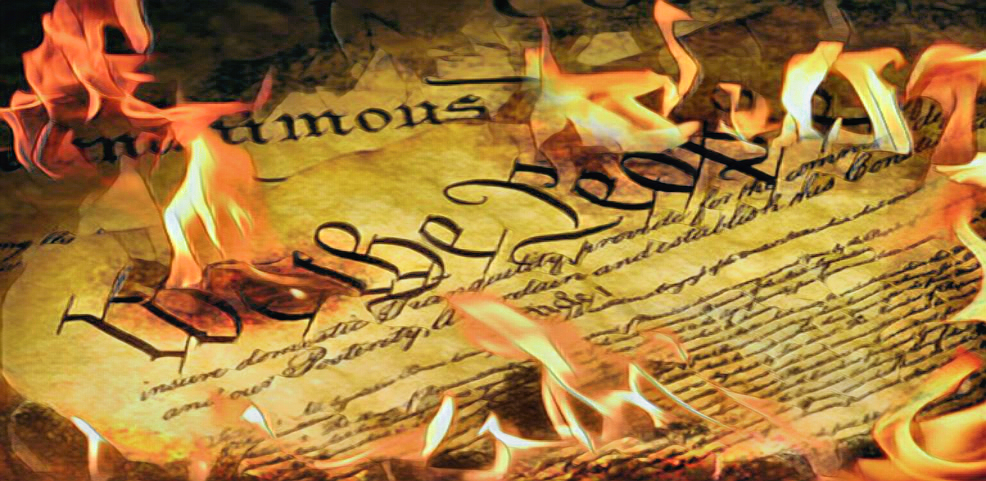
“We the People of the United States, in Order to form a more perfect Union, establish Justice, insure domestic Tranquility, provide for the common defense, promote the general Welfare, and secure the Blessings of Liberty to ourselves and our Posterity, do ordain and establish this Constitution for the United States of America.“
This is the preamble to the United States Constitution. It outlines the fundamental purposes and goals of the Constitution. Here’s a simple explanation of what it means:
- We the People of the United States: The authority comes from the citizens of the U.S., not just the government.
- in Order to form a more perfect Union: To create a stronger, better unified country.
- establish Justice: To create a fair legal system.
- insure domestic Tranquility: To maintain peace and order within the country.
- provide for the common Defense: To protect the nation from external threats.
- promote the general Welfare: To support the well-being and prosperity of all citizens.
- and secure the Blessings of Liberty to ourselves and our Posterity: To protect freedoms and rights not just for current citizens but for future generations.
- do ordain and establish this Constitution for the United States of America: We officially adopt and establish this document as the foundation of the U.S. government.
In essence, it states that the Constitution is created by the people to promote justice, peace, security, prosperity, and liberty for themselves and future Americans.
Inflammatory Rhetoric is Republicans’ Path to Power
Honest Americans are fed up with conservatives and evangelicals blaming Democrats for all the strife plaguing the nation. This reverse psychology is a false narrative spun by MAGA operatives to divert attention from their role in fostering division. They pursued power by stoking fear, grievance, and anger, using social media and conservative news channels to influence public opinion. Politics has been transformed into a reality-show spectacle, with viewers worldwide tuning in daily to get a play-by-play of who’s ahead and who’s falling behind in the game of one-upmanship between the Republican and Democratic parties—turning civic life into a bloodsport and leaving many voters disillusioned.
The Rise of Incendiary Rhetoric
Trump’s media persona, amplified by years on ‘The Celebrity Apprentice’ and decades of tabloid exposure, normalized brash, confrontational language and spectacle politics. Since launching his 2015 campaign, Trump regularly used loaded language—words chosen to evoke emotional reactions rather than reasoned debate—which research links to increased political polarization and affective hostility. Scholars have documented overlaps between several techniques of modern populist leaders and historical propaganda—scapegoating, repetition, de-legitimizing institutions—even as they caution against literal equivalence to totalitarian regimes. Yet, irrespective of his language, which often resembles that of a gangster boss, he has repeatedly tried to act like an authoritarian. Therefore, reasonable people are justified in calling him a fascist or even comparing him to Adolf Hitler, especially when he speaks in ways that incite violence or hatred. His supporters, many of whom adopt flag-waving, Nazi-like rhetoric, often echo his divisive language, creating a toxic environment that threatens the very foundations of democracy.
Scapegoating and Division
Throughout his political career, Trump has demonstrated a penchant for inflammatory statements. For instance, he scapegoated Mexican immigrants as “rapists” and criminals during his campaign launch on June 16, 2015—a statement that fueled their dehumanization. His repeated false claims about widespread voter fraud, culminated in the U.S. Capitol riot—because his cult followers believed the big lie that the 2020 election was stolen—have deepened distrust in the democratic process. These remarks, often delivered with a provocative flair, serve to deepen division and stir up resentment among his base.
Freedom of speech doesn’t mean freedom from the consequences. First Amendment protections guarantee that citizens won’t be arrested for speaking freely, as long as they aren’t guilty of incitement to imminent lawless action, true threats, defamation, certain obscenity, or falsely shouting “fire” in a crowded theater. Trump’s language and conduct resemble those of agitators who metaphorically shout “fire” in crowded spaces—an analogy often used to describe speech that incites panic or violence. Since 2015, he has used loaded language to stir emotions, often targeting minorities, political opponents, and the press. All activist movements are driven by emotion. Trump’s incendiary rhetoric fuels MAGA fanaticism and radicalizes the resistance. When people become emotionally charged and offended, they often seek to retaliate by punishing groups or individuals they perceive as enemies—through cancel culture, boycotts, or even violence.
The Authoritarian Impulse
Trump’s tendency to act like an authoritarian—calling critics “enemies of the people,” dismissing the free press as “fake news,” and issuing threats to political opponents—fuels a dangerous narrative. When he behaves irresponsibly, spewing incendiary rhetoric without regard for the consequences, his supporters often follow suit, blindly believing that no repercussions will come their way. His cult followers, many of whom are too blinded by loyalty to see the danger, fail to understand that fighting words are not harmless—they are weapons. When wielded recklessly, they can ignite a powder keg of anger, resentment, and violence. Moreover, Trump is arguably the worst “politically correct” offender in America, because MAGA Republicans have allowed him to spew divisive rhetoric and have provided cover for all his lies, making him the pathological liar-in-chief. Hypocritically, these same sycophants also want the government to collectively punish liberals when they feel offended, further fueling division and potential chaos.
When Trump claims he is the victim of a “witch hunt,” and warns that conservatives and evangelicals will lose their country, or suggests that if they can come for him, they can come for you, he is simply trying to manufacture a crisis. His supporters, often echo chambers on social media, amplify these narratives, further radicalizing individuals and increasing the risk of domestic terrorism. Trump has exemplified this dynamic, often dismissing critics as “enemies of the people” and fostering a narrative where political correctness is viewed as censorship rather than respect for diverse opinions.
Historically, similar patterns of rhetoric have led to violence and tyranny. Hitler’s propaganda machine manipulated mass sentiment through emotionally charged speeches and relentless scapegoating, ultimately leading to the Holocaust and World War II. Likewise, Trump’s divisive language—such as mocking political opponents and labeling immigrants as an “invasion and poisoning the blood of our country”—continues to fuel hostility and distrust.
His rhetoric encourages supporters to see political disagreement as a threat to their very existence, escalating tensions that could easily boil over into violence. For example, on August 8, 2019, Trump tweeted that four progressive Democratic congresswomen—often called “The Squad”—should “go back and help fix the totally broken and crime-infested places from which they came,” despite all four being American citizens. This racist and inflammatory comment stirred racial animosity and was widely condemned.
Another example is his campaign rallies, where he told supporters, “We have to beat the hell out of them; knock the crap out of them. I will pay for the legal fees”—referring to protesters and hecklers—an outright incitement to violence. During his presidency, his comments remained equally provocative. For instance, on September 3, 2020, during a rally in North Carolina, Trump told supporters to “liberate” states like Michigan and Virginia, which had Democratic governors, implying they should rebel against government authority. Such language is a clear call to action, emboldening supporters to act violently if they feel justified.
Perhaps most alarming was his conspiracy theory claiming that COVID-19 was “the China virus,” which fueled xenophobia and racism. His language often painted entire communities as threats, further dividing the nation. On October 22, 2020, just days before the presidential election, Trump suggested that voting by mail would lead to widespread fraud, calling it “the most corrupt election in American history,” despite a lack of evidence. Such statements undermine trust in the electoral process and threaten to incite violence or unrest if outcomes are perceived as illegitimate.
Tragically, on January 6, 2021, Trump’s repeated claims that the election was stolen culminated in a speech before the Capitol riot, where he urged his supporters to march to the Capitol and “fight like hell,” signaling them to challenge the certification of the electoral college results. His words directly contributed to the violent assault on the security officers of the Capitol building, a moment that will forever be remembered as a dark chapter in American history. His rhetoric about “stolen elections,” “rigged systems,” and “patriots fighting for their country” created an environment where his cult followers believed violence was justified to “save” the nation.
This climate of heightened polarization resembles the dangerous road rage seen in the streets—volatile, unpredictable, and destructive. Partisan narratives are as combustible as gasoline, with incendiary rhetoric increasing the risk of catastrophe. Such narratives act like tinder, easily igniting uncontrollable fires in communities. When conservative politicians and evangelical leaders engage in divisive speech, they play with fire, risking a rapid escalation that can consume everything in its path.
History warns us that such inflammatory language, if left unchecked, can lead to chaos, violence, and the erosion of democratic institutions. The danger lies not only in the words themselves but also in the willingness of followers to act on them. As a nation, it is crucial to recognize these dangerous patterns and reject rhetoric that incites violence and hatred. Only through a commitment to truth, respect, and unity can we hope to preserve the democracy we hold dear—and prevent the fires of division from consuming our entire society.
“Truth can bear any criticism, examination, or argument; it does not need censorship or propaganda to protect it. What needs censorship is propaganda—since it is a lie—and therefore, the vast majority of what MAGA sycophants and their echo chamber are expected to believe is a lie. When people who are honestly mistaken learn the truth, they will either cease to be mistaken or cease to be honest by attempting to debunk the subject matter experts.”
- Core idea: Political speech should be entirely free from government restriction; limits risk undermining self-rule.
- Philosophical roots: Linked to Meiklejohn, John Stuart Mill, and the “marketplace of ideas” — truth emerges from open debate.
- Typical stance: Opposes legal restraints on political expression and is wary of gatekeepers who decide acceptable speech.
- Scope disagreement: Some absolutists confined protection to political speech; many modern adopters extend the label to broad private-speech contexts.
Problems in practice
- Private vs public actors: Constitutional protections limit governments, not private platforms; private companies can set rules.
- Gatekeeping still exists: Platform owners, editors and wealthy purchasers control what reaches audiences even without state limits.
- Unequal amplification: Market incentives ensure uneven reach; removing moderation doesn’t produce equitable speech.
- Abuse and harm: Unrestricted speech can enable harassment, disinformation, and calls to violence (e.g., Trump).
- Practical contradictions: Promoters of absolutism (e.g., Musk, Trump) may themselves silence critics or apply rules inconsistently.
Role of politically correct norms
- Preventing derailment: Norms of politically correct (PC) speech—social expectations that discourage discriminatory, dehumanizing, or violent rhetoric—act as non‑legal guardrails that reduce harms when legal limits are absent.
- Social moderation vs legal censorship: PC norms enable communities and platforms to push back socially (boycotts, criticism, deplatforming) without invoking state censorship, helping prevent absolutists from promoting speech that incites violence or systemic harm.
- Checks on extremism: Cultural standards and reputational consequences make it harder for absolutist arguments to justify abuse; they encourage accountability where law does not reach.
Trade-offs (pros and cons)
- Pros: Avoids state‑led censorship; protects robust political debate; sidesteps value‑laden policing by government.
- Cons: Enables harms (misinformation, harassment, incitement); fails to address platform power imbalances; doesn’t guarantee fair amplification.
- Mitigating role of PC norms: While not a panacea, PC norms help mitigate harms without expanding state power, balancing absolutist impulses in practice.
Implications for Society at Large
- Musk invokes absolutism and a “digital town square,” but privatization concentrates editorial power and leaves outcomes shaped by platform incentives.
- Politically correct norms and community standards will remain important informal constraints to prevent unchecked speech from leading to real‑world harm or the proliferation of abusive actors (e.g., Musk, Trump).
Takeaway: Free speech absolutism defends near‑total protection for political expression, but private power, unequal amplification, and real‑world harms require social norms (including politically correct norms) as practical guardrails to prevent absolutist positions from going off the rails. Excerpts from: What Is Free Speech Absolutism? Who Is a Free speech Absolutist? Examples, Pros and Cons
Op-Ed: “Your suffering is never caused by the person you’re blaming.” Blame is an easy escape, but it never leads to freedom and encases you in a prison of false perception. It’s tempting to believe that suffering is caused by someone else—that their words, their actions, or their choices are the reason for the pain. But what if the real source of suffering isn’t what they did, but the way it is perceived, processed, and held onto?
The mind has a way of creating narratives. It builds stories around pain, assigning fault and attaching emotions to past wounds. But the moment blame is given away, power is also given away. Blame keeps the focus outward, waiting for someone else to change, apologize, or make things right. But what if peace doesn’t depend on their actions? What if it has always been an internal choice?
No one can control how others act. People will make mistakes, they will be unfair, they will disappoint. But what happens next—the response, the emotions carried forward, the way the situation is interpreted—is entirely within personal control. And this is where true strength lies: in realizing that suffering isn’t created by the external, but by the attachment to what cannot be changed.
Personal accountability is not about excusing others—it’s about reclaiming power. It’s the understanding that while pain is real, suffering is optional. It’s the choice to see difficult situations as lessons instead of burdens, to shift perspective from victim-hood to growth. The world will not always be kind, but inner peace is not determined by external forces.
Letting go of blame is not about denying hurt; it’s about refusing to let it define the future. When responsibility is taken for thoughts, reactions, and emotions, life no longer feels like something that happens TO YOU, but something shaped BY YOU.
Freedom begins the moment responsibility is claimed. The choice is always there: to remain bound by blame or to step forward in strength. In the end, the only true control is over oneself, and that is where real peace is found.
“The devil tempts us to bring out the worse in us, but God test us to bring out the best in us.” By: Warren Wiersbe
Commentary: When you perceive that someone is insulting you or saying something offensive, do you become upset because of what you have heard or read? Before anyone opens their mouth or types anything on social media, they must have thought about it first. In reality, the reason you become upset is not solely because of what was said; it is often because of your interpretation of another person’s thoughts. When you say, “How dare they say that,” what you really mean is, “How dare they have such a low opinion of me (or someone I care about).”
If you unfriend someone because of what you perceive they are thinking, it reflects a judgment that your thoughts are somehow more valid or ‘holier’ than theirs. And if you suspect that their thoughts are malicious or evil, you may want to disassociate yourself from them. This is unfair because you have no idea what experiences they have gone through to arrive at their current state of mind. In their life, they might have experienced happiness or endured hardships. Those experiences have shaped their thoughts, and sadly, they might still be struggling with some of them—especially considering the recent interactions they’ve had with you.
My extroverted dad once told me: “When I was younger, I could make friends easily. However, as time went by, people would see something in me they disliked, or I would discover something about them that I didn’t care for (because I would subconsciously profile them). Eventually, every time I met someone new, it would always come down to the same conclusion.” In the end, he realized that when someone unfriends you, it’s usually because they have given up trying to get you to validate them or because they no longer feel appreciated.
Experience has taught me that we need not be offended—that one of the most important signs of maturity is a refusal to take offense. We need not be angry, bitter, or insulted. We need not make our sister or brother an offender for “an inopportune word.” It really is not too difficult to look at a person’s heart—to try to understand what they meant to do, rather than what they did, or what they meant to say rather than what they actually said. Sometimes, this simply requires looking the other way and assuming the best.
“Is there a virtue more in need of application in our time than the virtue of forgiving and forgetting? There are those who would look upon this as a sign of weakness. Is it? I submit that it takes neither strength nor intelligence to brood in anger over wrongs suffered, to go through life with a spirit of vindictiveness, or to dissipate one’s abilities in planning retribution. There is no peace in nursing a grudge. There is no happiness in living for the day when you can ‘get even.’” By: Gordon B. Hinckley
“Our civilization is decadent, and our language […] must inevitably share in the general collapse.[…] Political speech and writing are largely the defense of the indefensible.” By: George Orwell
Ultimately, history teaches us that temporary peace achieved through authoritarianism is often an illusion, and the true cost is the erosion of civil rights, individual freedoms, and the rule of law. Democratic societies must remain vigilant, fostering compromise and understanding, even amid polarization. Otherwise, they risk sliding into cycles of authoritarianism, where the promise of stability masks the suppression of dissent and the consolidation of power by a few.“If our democracy dies, the reason won’t be that Americans were too apathetic to save it; it will be that they voted it out of existence.” By: H. Scott Butler
“Though liberty is established by law, we must be vigilant, for liberty to enslave us is always present under that same liberty. Our Constitution speaks of the ‘general welfare of the people’. Under that phrase all sorts of excesses can be employed by [authoritarian] tyrants—to make us bondsmen.” By: Marcus Tullius Cicero
“Tyranny feeds on fear, silencing voices and binding wills; democracy prevails through courage—raising voices and resisting in the shadows.” By: A. Freeman
“Under Trump, we’ve lost decency. We’ve lost civility. We’ve lost respect for the rule of law. We’ve normalized verbal abuse on the internet. We’ve normalized bullying. As much as the woke generation tried to change that, it’s back. Out the window goes character and integrity. Nobody has great things to say about politicians, but ideally, we’re supposed to elect the best of us, not the worst. He embodies everything that’s wrong, not just with America, but with being human.” By: Jeff Daniels
“First they came for the socialists, and I did not speak out—because I was not a socialist.
Then they came for the trade unionists, and I did not speak out—because I was not a trade unionist.
Then they came for the Jews, and I did not speak out—because I was not a Jew.
Then they came for me—and there was no one left to speak for me.” By: Pastor Martin Niemöller
“It is we who nourish the ‘Soul Of The World’, and the world we live in will be either better or worse, depending on whether we become better or worse.” By: Paulo Coelho
 elroypoet.blog