

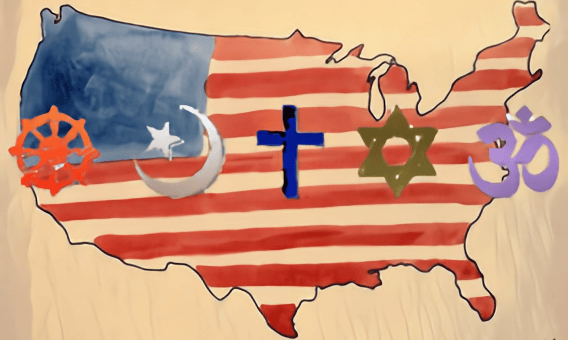
God has a plan for me,
God has a plan for you,
and you know what,
It is the same plan,
because He loves me
as much as He loves you.
He is our Creator,
and we are His creation.
That’s why He wants us to live in peace
with each other.
He has provided everything we need;
He gave us this Earth,
and He gave us His Heart.
Edited by: ElRoyPoet, 2026
Arguments about the value of organized religion are not, in the first instance, theological. They are anthropological, psychological, and political. They concern what human beings need, what they fear, how they construct meaning, and how societies preserve moral order. Whether God exists is a separate question from whether religion performs indispensable functions for human beings. A religion can be false in its metaphysical claims and still be powerful, useful, consoling, or dangerous. Conversely, it can be true and still be socially destructive when joined to power, coercion, or tribalism.
Voltaire’s observation that “if God did not exist, it would be necessary to invent him” points toward this distinction. The statement need not be read as an argument for or against God. It can be understood as a claim about the human tendency to create symbolic systems that make suffering intelligible and moral obligations authoritative. Twain’s remark that human beings are the only animals that pray — or that need to pray — makes a related point. Prayer expresses dependence, but it also expresses the desire to place private suffering within a larger order. It is an attempt to speak to the universe, even when the universe does not answer.
Religion may therefore exist partly because human beings are predisposed toward it. We search for agency behind events, infer purpose from patterns, form strong group identities, and look for rules that transcend individual preference. These tendencies may have evolutionary origins. Shared rituals bind groups together; common stories create trust; belief in supernatural surveillance can encourage cooperation even when no human authority is watching. None of this proves that God is unreal. It means only that the human capacity for religion can be explained without settling the question of whether its object exists. Our tendency to hunger does not prove that every food is nourishing, but neither does it prove that food is imaginary.
This is where the comparison between atheism and religion becomes provocative. Atheism, strictly defined, is simply the absence of belief in God. It is not a complete moral system, political program, or account of human flourishing. But public atheism often becomes something more expansive: a movement that argues that religion is not merely mistaken but socially harmful, and that society would improve if religious belief disappeared. That larger claim requires evidence. It cannot be established merely by demonstrating that some religious propositions lack sufficient evidence.
When atheism is organized around shared authorities, canonical arguments, moral certainties, public rituals, heroic founders, and a vision of collective redemption, it can begin to resemble the social structure of a religion. The object of worship may be replaced by humanity, reason, science, progress, the state, or the liberated individual. The afterlife may be replaced by a perfected future society. Sin may become ignorance, bigotry, or insufficient political consciousness. Heresy may consist in questioning the movement’s favored conclusions. This does not make atheism itself a religion any more than political parties, universities, or scientific institutions are religions. It does show that human beings can reproduce religious patterns even after rejecting the supernatural.
The relevant contrast, then, is not simply religion versus atheism. It is humility versus certainty, openness versus dogmatism, and institutions that permit dissent versus institutions that punish it. Religious believers can be intellectually humble, morally serious, and tolerant of uncertainty. Atheists can be dogmatic, intolerant, and animated by faith in propositions they cannot prove. The disappearance of supernatural belief would not automatically eliminate fanaticism. It might merely redirect it toward secular objects.
Religion has historically served at least two central purposes: comfort and morality. Its comfort is often dismissed as childish or irrational, but the need for consolation is not confined to the unintelligent. Human beings suffer losses they cannot repair, face deaths they cannot prevent, and endure injustices that may never be corrected. The belief that suffering is not meaningless, that the dead are not simply erased, or that justice exists beyond the limits of earthly institutions can make life bearable. A person whose home has been destroyed and whose neighbors have died may thank God for survival not because they believe the destruction was good, but because gratitude gives shape to an experience that otherwise feels arbitrary and unbearable. The theological interpretation may be questionable; the psychological function is real.
There is also a moral dimension to such gratitude. It can express humility before forces beyond one’s control, recognition of dependence on others, or a sense of obligation to use one’s survival well. Of course, religious consolation can also become morally evasive. If every event is described as part of a divine plan, suffering can be rationalized rather than relieved. Gratitude can become a way of ignoring the victims who were not spared. Religion can console, but consolation is not the same as explanation, and faith does not excuse indifference.
Its moral function is equally complex. Religions do not possess a monopoly on morality, but they have often provided moral language that is accessible to people who do not have the leisure, education, or social security required to construct an ethical theory from first principles. “Do not murder,” “care for the stranger,” “feed the hungry,” “forgive,” “do not bear false witness,” and “the powerful will be judged” are not academic propositions. They are memorable commands embedded in stories, rituals, and communities. They can be taught to children, repeated in moments of temptation, and applied by ordinary people who have never read a work of moral philosophy.
This matters because moral knowledge is not distributed evenly, and moral reasoning does not take place under equal conditions. For the affluent and educated, ethics can appear to be a matter of abstract reflection. They may have the time and security to debate consequentialism, virtue ethics, rights, autonomy, or the foundations of objective value. For those whose lives are shaped by poverty, violence, precarious work, illness, discrimination, or social abandonment, morality may need to arrive in a more immediate form. It must tell them whom to trust, what obligations they have to one another, what kinds of behavior are shameful, and why their suffering does not make them worthless.
That does not mean poor people are incapable of philosophical thought, nor that elites are incapable of religious faith. It means that moral systems perform different functions under different social conditions. A wealthy person may be able to treat morality as a personal project. Someone living amid instability may need morality as a shared institution: a network of expectations sustained by family, congregation, neighborhood, and tradition. Attacking that institution without offering a substitute can leave people not liberated but disoriented.
Secular societies have developed alternative sources of moral authority — constitutional rights, civic education, humanism, democratic participation, professional ethics, and social welfare institutions. These alternatives can be admirable and in some respects superior to religious authority. But they face a problem religion has long addressed: why should moral obligations bind us when violating them would benefit us and carry no immediate penalty? A secular answer can appeal to reciprocity, empathy, human dignity, social stability, or the conditions necessary for everyone to flourish. Those are serious answers. They are not necessarily easy answers, and they do not become persuasive merely because they are secular.
The strongest criticism of public atheism, therefore, is not that atheists cannot be moral. They plainly can. Nor is it that religion is always beneficial. It plainly is not. The stronger criticism is that some atheists mistake the removal of religious belief for the removal of the human needs that produced religion. People will still seek meaning, belonging, absolution, authority, ritual, and hope. If traditional religion retreats, those needs will not vanish. They will migrate into politics, nationalism, consumer culture, therapeutic ideologies, technological idealism, or other movements that may be less honest about their own quasi-religious character.
The question is not whether humanity can live without churches, scriptures, or belief in God. It is whether humanity can live without the functions those institutions have served. Can a society offer consolation without lying, morality without coercion, community without tribalism, and hope without promising certainty? Can it acknowledge that suffering is often arbitrary while still giving people reasons to endure and obligations toward one another?
Organized religion deserves criticism when it protects cruelty, suppresses inquiry, or turns power into sacred authority. But the mere fact that religious belief can be explained psychologically does not make it worthless or false. Nor does the mere fact that atheism can be argued rationally make every secular vision of society humane or realistic. The human appetite for religion may be a weakness, a survival mechanism, a source of wisdom, or all three at once. If atheism is a truth many people cannot handle, it may be because human beings require more than truth in the narrow sense. They require a story within which truth, suffering, duty, death, and hope can coexist.
Questions and Answers:
1. Why are arguments about religion not theological?
The focus is on functionalism rather than metaphysics. From a psychological standpoint, this mirrors the study of Evolutionary Psychology, which examines how behaviors (like religious impulse) evolve to solve adaptive problems. The argument is that religion serves a biological purpose — reducing anxiety and providing social structure — regardless of whether the underlying theology is factually true.
2. What is the psychological basis for the claim that man would “invent” God?
This refers to Agent Detection, a cognitive bias where humans tend to perceive intentional agency behind random events. Evolutionarily, it was safer for an ancestor to mistake a rustling bush for a predator (a false positive) than to mistake a predator for the wind (a false negative). This innate tendency to assign “will” to the environment makes the concept of a Creator a natural cognitive output.
3. Why is the human need for prayer described as a biological demand?
Prayer can be viewed through the lens of Emotional Regulation. By externalizing stress and appealing to a higher power, individuals engage in a form of cognitive reframing that lowers cortisol levels and reduces the feeling of helplessness. The “demand” is not for a deity, but for the psychological relief that the act of praying provides.
4. How can the “truth” of atheism be considered “too much for humans to handle”?
This relates to Existential Dread and the “Terror Management Theory” (TMT). TMT suggests that human culture and religion are essentially defense mechanisms against the paralyzing fear of death and insignificance. A purely atheistic, materialistic universe offers no inherent meaning or afterlife, which can trigger profound existential anxiety that many are not psychologically equipped to process.
5. In what way does public atheism mirror organized religion?
It shifts from a “lack of belief” to a “belief in a specific outcome” — specifically, the dogma that society is improved by the absence of faith. This creates an In-group/Out-group Dynamic, where the atheist community develops its own shared values, moral imperatives, and a vision of a more ideal future, mimicking the sociological structure of a religious sect.
6. What psychological mechanism explains people thanking God during a catastrophe?
This is a classic example of Cognitive Dissonance reduction. When a person experiences the trauma of losing their home but survives, the brain struggles to reconcile the horror with their survival. Attributing survival to “divine mercy” provides a narrative that resolves the dissonance, transforming a random survivor’s guilt into a sense of purpose or being “chosen.”
7. How does religion provide “comfort” in the face of hardship?
It utilizes Positive Reappraisal, a coping strategy where a person focuses on the potential “silver lining” or a higher purpose behind a negative event. By believing a beneficent God has a reason for the pain, the individual transforms an acute trauma into a manageable trial, which prevents psychological collapse.
8. Why is the acquisition of moral knowledge easier for the “elites” than the “rest of us”?
This points to Maslow’s Hierarchy of Needs. Those whose physiological and safety needs are met (the affluent) have the “cognitive bandwidth” to engage in abstract moral philosophy. For those in survival mode, morality is often tied to immediate social cohesion and divine mandates, which provide clear, actionable rules for survival without requiring the luxury of philosophical deliberation.
9. Is religion a “lie”?
Not necessarily. Religion is a Psychological Tool. In psychology, a “functional truth” is something that works to maintain the stability of the individual or group, regardless of its empirical accuracy. The author suggests that the “value” of religion lies in its effectiveness as a survival mechanism, not its accuracy as a map of the cosmos.
10. What is the overarching psychological conclusion of the theme?
The conclusion is that humans are Meaning-Making Animals. Our brains are not designed to find objective truth, but to find patterns that ensure survival. Therefore, the tension between atheism and religion is not a battle between “fact” and “fiction,” but a conflict between an empirical truth (atheism) and a biological necessity (faith).
Disclosure:
This post was developed through human-AI collaboration, combining original editorial perspectives with scholarly research. The editor maintains academic integrity and assumes full intellectual responsibility for the theme and its conclusion. All links are property of their respective authors. FOR EDUCATIONAL AND INFORMATIONAL PURPOSES ONLY. NOT LEGAL OR MEDICAL ADVICE.

