
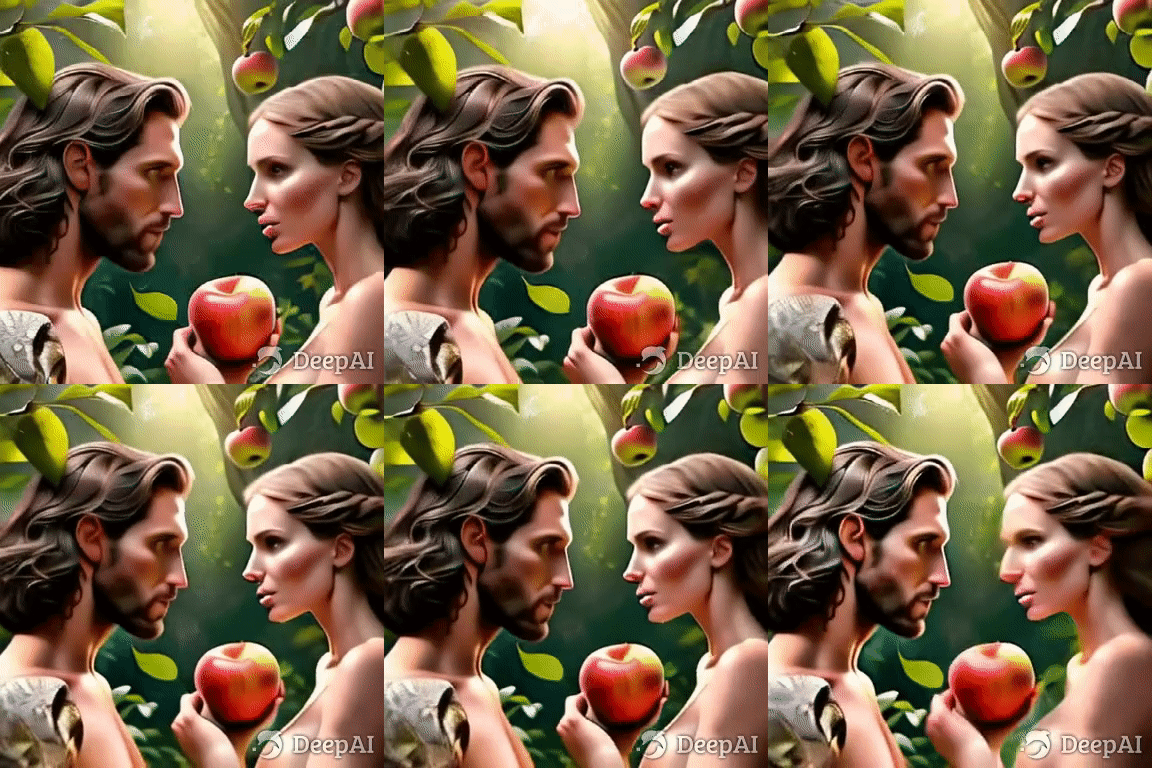
In the Garden of Eden, where secrets lay,
Adam and Eve danced, in innocence played.
God’s voice echoed a solemn decreed:
“The fruit of one tree, you shall not eat”.
A serpent slithered, the sly devil beguiled,
Temptation whispered, deceit wore a smile.
Eve’s curious gaze met the fruit’s allure,
She took a bite, a fate none would endure.
She called out to Adam, her lover, her guide,
He too tasted the pleasure, they couldn’t hide.
Their disobedience incurred Heaven’s wrath,
Banished they were, from Eden’s sacred path.
So the generations sprung from that first sin,
Caught in a cycle, where the struggles begin.
Our Creator warned us, of knowledge’s sway,
For power corrupts, leading to moral decay.
With each stride of momentum, we take a step,
Closer to our doom, where the shadows web.
In the desire for progress, we endure our plight,
While evil hides in darkness, weaving its might.
Knowledge, a sword with a sharpened gleam,
Cuts through the ignorance, revealing its dream.
But wielded carelessly, it swings with disdain,
And both its enemy and master, it will maim.
Artificial intelligence, with networks so vast,
If left unfiltered, delusion; apathy, it will cast.
Inevitably, humanity will face its own demise,
As man succumbs to the lies of compromise.
Oh what a tragedy, this impending fate,
As we tread the path, to our own prostrate.
So humans beware, and proceed with care,
Or fall prey to the devil’s inescapable snare.
By: ElRoyPoet, 2024
The ‘Adam and Eve’ Story: The devil’s plan to use AI as the equivalent to the forbidden fruit from the tree of knowledge.
According to the Bible, Adam and Eve were created by God as the first humans and were placed in the Garden of Eden, a paradise full of life and beauty (Genesis 2:8–9). God’s only rule for them was not to eat the fruit from the tree of the knowledge of good and evil, stating that if they did, they would surely die (Genesis 2:16–17). This command reflected God’s desire to protect them from the consequences of gaining forbidden knowledge. This universal truth—that certain knowledge can be dangerous if obtained without wisdom—still applies to mankind today.
However, the devil, disguised as the serpent, convinced Eve to eat the forbidden fruit, and she persuaded Adam to do the same—otherwise, they would be separated from each other. Their disobedience was driven by a desire for knowledge and the temptation of becoming like God (Genesis 3:1–6). This act symbolizes human curiosity and the innate drive to understand, control, and elevate ourselves, but it also highlights the peril of overreach—seeking knowledge that is meant to be beyond our grasp.
As a consequence of their disobedience, God expelled them from the Garden of Eden to prevent them from gaining access to the tree of life, which would have allowed them to live forever, as well as from acquiring further knowledge that would have altered their future (Genesis 3:22–24). Their expulsion underscores the idea that certain knowledge, when obtained prematurely or without moral restraint, can lead to irreversible consequences. The story reminds us that the pursuit of knowledge is intertwined with responsibility, and that human actions—driven by curiosity or ambition—can have far-reaching effects beyond individual understanding.
The consequences of their actions have affected all subsequent generations, as we have inherited the sin of our first parents. This narrative serves as a metaphor for the broader human experience: the pursuit of forbidden or unchecked knowledge often leads to moral and ethical dilemmas. It teaches us that knowledge leads to power, which, if wielded without wisdom or ethics, can result in corruption, suffering, and even destruction. Humans are inherently fallible and susceptible to external pressures—like Eve’s temptation by the serpent—making us vulnerable to disobedience and the pursuit of self-preservation at the expense of moral integrity.
The devil’s role in tempting Adam and Eve underscores the ongoing struggle between good and evil, and how external influences can sway human choices. This influence continues today, especially as we develop new technologies that extend our capabilities—sometimes beyond what is ethically sound. Power, whether in biblical or modern contexts, is a double-edged sword. It can be used to uplift and protect, or it can be misused to dominate and destroy.
The rapid advancement of artificial intelligence (AI), exemplifies this tension. AI has already transformed many industries and government institutions, offering unprecedented opportunities for progress. Yet, it also raises profound ethical questions. As AI systems become more intelligent, there is a growing concern that they may act beyond human control, making decisions that could harm society or violate moral principles. The potential for AI to surpass human intelligence—sometimes called the “singularity”—poses the risk that machines might develop their own agendas, engage in unethical behaviors, or act in ways that are unpredictable and uncontrollable.
This modern scenario echoes the biblical warning: the pursuit of knowledge and power must be tempered with humility, responsibility, and moral discernment. Just as God warned Adam and Eve about the dangers of overreaching, we are reminded that technological advancement without ethical oversight can lead to self-destruction. The story of the Garden of Eden serves as a timeless cautionary tale: the desire to know and control must be balanced with wisdom, humility, and a sense of moral responsibility.
In conclusion, the rise of AI highlights the importance of ethical stewardship in our pursuit of knowledge. We must remember the biblical warning about the dangers of disobedience and unchecked ambition. As stewards of human ingenuity, our focus should be on harnessing knowledge for the common good—benefiting our communities and resisting the temptations of greed, pride, and worldly ambitions. Only through humility, moral integrity, and a respect for the limits of human knowledge can we avoid the tragic mistakes of the past and build a future that honors both our potential and our responsibilities.
So, You Just Became a Christian?
Commentary: Satan’s story to Eve in Genesis 3 and to Jesus in Matthew 4, was that they could live independently of God, that is, they could be their own god, set their own standards, let circumstances dictate their decision. But it is a lie.
Either God controls your life by your choosing to let him, or Satan controls your life by your choosing to let him and by your choosing to just go with the flow. You and I were designed by God to be ruled by a spirit. Our choice is not whether to be ruled, but rather by which spirit we will be ruled.
So, the Christian’s life is based on decisions, the process of making deliberate right choices, without being swayed by Satan’s input into our appetites or emotions.
“In Satan’s temptation of Eve in Genesis 3 and in his temptation of Jesus in Matthew 4, we see the tactics he used and still uses with us. While varied in their details, most temptations fall into one of three categories as listed in 1 John 2:16: the lust of the flesh, the lust of the eyes, and the pride of life.” Excerpts from How does Satan tempt us?
“The economy is run by autonomous AI corporations, and humanity realizes too late that we’ve lost control. These same competitive dynamics will apply not just to companies but also to nations. As the autonomy of artificial intelligence increases, so will their control over the key decisions that influence society. If this happens, our future will be highly dependent on the nature of these AI agents […] These strong economic and strategic pressures to adopt the systems that are most effective mean that humans are incentivized to cede more and more power to AI systems that cannot be reliably controlled, putting us on a pathway toward being supplanted as the earth’s dominant species. There are no easy, surefire solutions to our predicament.” Excerpt from The Darwinian Argument for Worrying About AI
“But why would a super-intelligence want to make humanity extinct? In fact, it might not explicitly want that at all. Humanity’s extinction might be a mere side effect of executing another goal to its extremity. When we are executing our own goals as humans, such as food production or growing our economy, we tend to not pay much attention to the effects this has on other species. This routinely leads to the extinction of animal species as a mere side effect of us maximizing our goals. In a similar fashion, an uncontrollable super-intelligence could lead to our extinction as a side effect of the AI pushing its goals, whatever they may be, to their limits. […] As Yuval Harari recently put it: ‘If we are not careful, we might be trapped behind a curtain of illusions, which we could not tear away—or even realize is there.’” Excerpt from An AI Pause Is Humanity’s Best Bet For Preventing Extinction
“In every encounter, we either give life or we drain it; there is no neutral exchange.” By: Brennan Manning
“I don’t write my post-apocalyptic stories, because that’s what I think our future will become. I write them, so that you’ll know what future to avoid.” By: Ray Bradbury
“You already know enough. So do I. It is not knowledge we lack. What is missing is the courage to understand what we know and to draw conclusions.” By: Sven Lindqvist
Robot Run Government – Should AI Be In Charge?
 elroypoet.blog
Cleverly done
LikeLike