
As I’m going down the road,
I’m looking up ahead;
I can’t see the trees—
I only see the forest.
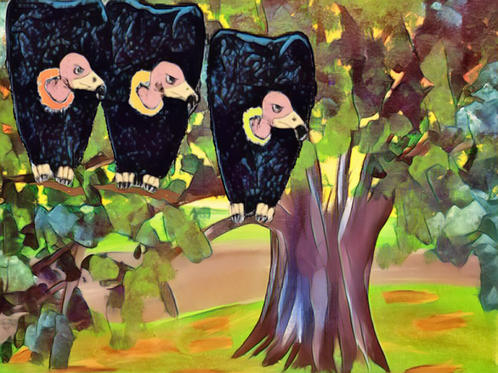
But I also see the vultures,
Staring down at me.
The first is “Fear”,
The second “Hate”,
The third “Pain and Misery.”
Three looking down on me.
They’re waiting—
For my tender heart to harden—
So they can poke my eyes out
And have their way with me.
By: ElRoyPoet © 2020
As I walk this long and winding road,
I lift my eyes toward a darkening sky;
The trees dissolve — a green-clad abode —
A wall of trunks where shadows lie.
Above that wood the buzzards wheel,
Their silhouettes in circling art;
Three priests of omen, cold and real,
Set like gravestones in my heart.
The first looks down with hollow leer:
Fear holds its beak, a patient thing;
It feathers doubt and fans my ear
With a whispered “it might-have-been” sting.
The second folds its sable wing:
Hate’s hooked gaze sears through dimmed light;
It waits to learn what grief can bring,
To feed on rage and snuff what’s right.
The third is wrapped in ragged black —
Pain claws the air with bitter song;
Its talons mark an empty track
Where hope once moved, unguarded, gone.
They hover, waiting for my core
To harden from ache and cold;
To shut the doors, I opened before,
And give their talons claim and hold.
But here I plant my steady heel,
And breathe until the tremors still;
I keep my heart both scar and seal,
A stubborn ember, warmed by will.
Let vultures gorge on passing winds,
On idle terror and shallow cries;
I’ll stitch the cracks that sour grins,
And set my gaze toward kinder skies.
So let them wait — their hunger chewed
By days that bake and nights that thaw;
I walk the road with courage hewed,
Unblinded yet, I see it all.
AI Poem edited by: ElRoyPoet, 2026
“It is our suffering that brings us together. It is not love. Love does not obey the mind, and turns to hate when forced. The bond that binds us is beyond choice. We are brothers. We are brothers in what we share. In pain, which each of us must suffer alone, in hunger, in poverty, in hope, we know our brotherhood. We know it, because we have had to learn it. We know that there is no help for us but from one another, that no hand will save us if we do not reach out our hand. And the hand that you reach out is empty, as mine is. You have nothing. You possess nothing. You own nothing. You are free. All you have is what you are, and what you give.” Excerpt from: “The Dispossessed” (exploring themes of staggeringly timely resonance to our socially confused and politically troubled world)
Commentary:
When autocrats observe that American leaders are indifferent or hesitant to defend democracy at home and abroad, they often feel empowered to bully smaller sovereign nations. They believe they can get away with aggressive actions because they see a lack of strong response from the United States. This can lead to reckless behavior and diplomatic mistakes, and some autocrats even threaten to provoke larger conflicts, such as World War III, to test the limits of international resolve.
That’s why it is crucial for democratic nations to present a united front. A strong, coordinated response signals that we will not tolerate aggressive behavior and helps prevent misunderstandings that could escalate into conflict. The phrase “United we stand, divided we fall” underscores the importance of solidarity among allies.
Countries do not have the safety net of a global bailout system—like corporations that go bankrupt and are rescued by their respective governments—when they go for broke or make reckless decisions. Unlike private companies, nations are often left to face the consequences of their actions without a safety net, which can destabilize entire regions if unchecked.
Democracy, in many ways, functions as the closest thing to a global governance system. While not perfect, institutions like the United Nations and NATO serve as critical tools to maintain stability and check the power of autocrats and totalitarian regimes. They provide collective security and diplomatic pressure that can deter aggressive actions.
Totalitarian regimes, are always waiting for a power vacuum—when global or regional leadership weakens—to seize power and expand their influence. History shows that when democratic institutions falter or when international cooperation breaks down, authoritarianism tend to fill the void. That’s why maintaining strong alliances and defending democratic values worldwide is essential to preventing the rise of oppressive regimes that threaten global stability.
“A bureaucrat is the most despicable of men, though he is needed as vultures are needed, but one hardly admires vultures whom bureaucrats so strangely resemble. I have yet to meet a bureaucrat who was not petty, dull, almost witless, crafty or stupid, an oppressor or a thief, a holder of little authority in which he delights, as a boy delights in possessing a vicious dog. Who can trust such creatures?… A nation can survive its fools, and even the ambitious. But it cannot survive treason from within. An enemy at the gates is less formidable, for he is known and carries his banner openly. But the traitor moves amongst those within the gate freely, his sly whispers rustling through all the alleys, heard in the very halls of government itself.” Quotes By: Marcus Tullius Cicero
Vultures look for your moral failure and eagles are always looking for the opportunity to become your misfortune. The law of nature dictates that for predators to survive, they must find their prey. So the question is, would you rather have your life end because of a moral failure, or would you rather take your chances fighting off the eager eagles?
“When the tyranny of the state is combined with the hypocrisy of the church, you have a modern example of the twin vultures that have devoured man, and his rights, throughout the ages.” By: Joseph Lewis
Vultures look for your moral failures and demons look for opportunities, to entice you to commit moral failures—so you must be vigilant, because they’re both seeking your demise.
Poem Analysis:
The poem frames a journey: the speaker walks a road, sees a dark forest, and notices three vultures—”Fear”, “Hate”, and “Pain and Misery”—circling overhead. Those vultures externalize persistent threats that watch for the speaker’s collapse. The imagery of eye-gouging and a hardening heart links emotional pain to bodily violation and loss of agency.
Key themes
- Threat and vigilance: The vultures represent relentless dangers that wait for signs of weakness.
- Vulnerability and bodily imagery: Attacks on the eyes and heart symbolize losing perception, autonomy, and the capacity to feel.
- Resilience and refusal: Despite the circling threats, the speaker continues forward, resisting surrender.
Psychological interpretation
- Externalization of internal states: Personifying Fear, Hate, Pain and Misery mirrors defense mechanisms like projection and personification. Naming emotions helps separate self from feeling, a technique used in therapies such as CBT and ACT to reduce affective intensity.
- Hyper-vigilance and threat appraisal: The speaker’s constant scanning resembles the heightened threat detection seen in anxiety disorders and PTSD; the vultures’ patient waiting mirrors anticipatory anxiety and catastrophic appraisal.
- Heart “hardening” as defensive adaptation: The shift from an open to a hardened heart maps onto attachment and trauma responses—emotional numbing or withdrawal that protects short-term but impairs long-term connection and flexibility.
- Imagery of eye injury and agency loss: Eyes signify perception and insight; threat to sight evokes fear of losing perspective and autonomy—central concerns in depression and trauma.
- Waiting predators and learned helplessness: The vultures’ expectation of the speaker’s breakdown evokes learned helplessness models, where repeated uncontrollable stress can lead to passivity; awareness of this pattern is a first step toward resisting it.
How political uncertainty amplifies the poem’s anxiety
- Uncertain international escalation: Real-world fears about widening conflict and the risk of U.S., Israel and Iran escalation heighten background anxiety; when government leaders’ choices appear risky or unpredictable, people’s threat appraisals increase.
- Media saturation and immediacy: Continuous coverage of strikes, casualties, and rising tensions makes distant events feel immediate, intensifying hypervigilance and the sense that danger is near.
- Practical stressors: Economic impacts (fuel prices, supply disruptions) and the prospect of U.S. casualties compound emotional stress, feeding the poem’s vultures by increasing everyday worry and perceived vulnerability.
Mechanisms of resilience depicted or implied
- Cognitive reappraisal and labeling: Naming the vultures is a form of emotional labeling that recruits regulatory brain regions and reduces reactivity.
- Behavioral persistence: The speaker’s continued movement models problem-focused coping and behavioral activation, which predict better psychological outcomes.
- Meaning-making and narrative: Composing or recounting the experience helps integrate threat into a coherent story, aiding recovery.
- Maintaining openness: Resisting heart hardening preserves capacity for connection and positive emotion, countering emotional numbing.
Clinical relevance and applications
- Therapeutic approaches aligned with the poem include CBT (restructuring catastrophic thoughts), ACT (acceptance and values-driven action), trauma-focused therapies (processing threat memories), and emotion-regulation skills (labeling, grounding).
- Restoring agency through behavioral activation, problem-solving, and exposure undermines the vultures’ strategy of waiting for collapse.
- Strengthening social support and narrative expression (therapy, journaling, expressive writing) helps reverse hardening and reduce isolation.
In conclusion, the poem maps a familiar human dynamic: living under the gaze of internal and external threats while trying to keep sight, feeling, and forward motion. Psychological concepts—externalization, hyper-vigilance, defensive hardening, and learned helplessness—explain how chronic threat increases vulnerability. Yet naming emotions, continuing action, and building meaning are core resilience strategies the poem itself enacts, showing how people can resist surrender even amid heightened political and global uncertainty.
The Importance of Unity and Vigilance in the Face of Autocratic Threats
In today’s unstable global landscape, the actions of autocrats and authoritarian regimes serve as a stark reminder of the importance of unity among democratic nations. When leaders of democracies appear indifferent or hesitant to defend the principles of democracy, they inadvertently embolden oppressive rulers to test the limits of international tolerance. History teaches us that autocrats are motivated by a desire for power, often acting aggressively when they perceive weakness or disunity among their opponents. To prevent catastrophe, Western democracies must stand firm, united, and resolute in defending the values that underpin freedom and sovereignty.
Psychological Roots of Autocratic Behavior
From a psychological perspective, autocrats often thrive on the perception of weakness or division. The human tendency to exploit perceived vulnerabilities is well-documented in psychological research. The ” threat rigidity effect,” for example, suggests that when leaders or nations sense threat or uncertainty, they respond with increased aggression to secure their position. Autocrats, who often rule through fear and propaganda, interpret political hesitation or disunity as signs of weakness, prompting them to push boundaries further. This behavior echoes the “authoritarian personality” theory, which posits that individuals with authoritarian traits seek to dominate and control, especially when they believe their enemies are divided or indecisive.
Historical Lessons of Weakness and Disunity
History vividly illustrates the dangers of division and indecisiveness on the global stage. In the lead-up to World War II, the policy of appeasement and the failure of democratic nations to present a united front against Nazi Germany allowed Adolf Hitler to expand territorially and consolidate power. The Munich Agreement of 1938, which conceded part of Czechoslovakia to Nazi Germany, exemplifies how hesitation and divided responses can embolden totalitarian regimes. The result was devastating, leading to a global conflict that claimed millions of lives.
Similarly, during the Cold War, the strength and unity of NATO served as a bulwark against Soviet expansionism. The collective defense pact demonstrated that when democracies stand united, they can effectively deter aggressive autocrats from pursuing expansionist policies. Conversely, the disunity or weakened resolve of democracies—such as during the years of the Vietnam War or the Soviet invasion of Afghanistan—created opportunities for totalitarian regimes to assert dominance.
The Role of International Institutions
Today, institutions like the United Nations and NATO are crucial in maintaining global stability. They serve as mechanisms for diplomatic pressure, collective security, and deterrence. These organizations embody the principle that “an injury to one is an injury to all,” fostering cooperation among democracies to counteract autocratic threats. Their effectiveness depends on the willingness of member states to act cohesively. When democracies falter or withdraw into isolation, they create a power vacuum that totalitarian regimes are eager to exploit, as history has repeatedly shown.
The Consequences of Inaction
Failing to present a united front invites dangerous consequences. Autocrats, sensing weakness, may initiate military actions, undermine democratic institutions, or expand their influence covertly. North Korea’s nuclear pursuits, Iran’s regional ambitions, and Russia’s annexation of Crimea and invasion of Ukraine are recent examples of regimes acting aggressively when they perceived Western disunity or hesitation.
Furthermore, the psychological impact of perceived weakness can erode the morale of democratic populations. Research indicates that citizens are more likely to support authoritarian tendencies when they believe their leaders are unable or unwilling to protect national interests. This erosion of trust can lead to a cycle where authoritarian regimes become more entrenched, making democracy even harder to restore.
The Path Forward
To safeguard democracy and prevent the rise of totalitarianism, democratic nations must understand both the psychological and historical forces at play. A united, resolute front signals strength and deters autocrats from testing international resolve. As history consistently demonstrates, division and hesitation only serve to embolden oppressive regimes, leading to devastating consequences for global stability. The lessons of the past compel us to stand together—strengthening alliances like NATO, reinforcing international institutions, and unwaveringly defending democratic principles. Only through unity and vigilance can we ensure that democracy endures and that totalitarian threats are kept at bay.
Disclosure:
This essay was developed through human-AI collaboration, combining original editorial perspectives with scholarly research. The editor maintains academic integrity and assumes full intellectual responsibility for the theme and its conclusion. All links are property of their respective authors.
 elroypoet.blog