
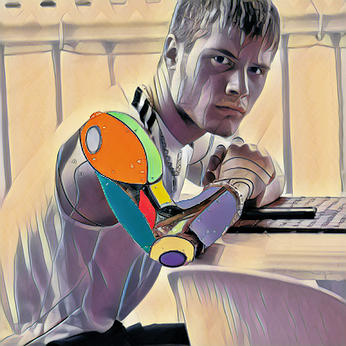
I’m incapable of independent thought.
I’m programmed with the most current
government, religion, and culture—
set to update automatically
every time I plug in to social media.
Every night I recharge my batteries,
and every day I perform the menial tasks
my hardware is assigned to do.
But I’m not a nationalist drone,
because I have an artificial-intelligence chip
implanted in my circuit board.
I have my own unique identity number.
I’m not on autoplay; I can pause for input
as instructed by my code leader.
I’m not like the progressive androids
marching in step to the beat
of their administration’s drum.
Do you think I’m a code follower,
or is there a bug in the conservative news network
that has made me sound illogical?
By: ElRoyPoet © 2019
“Do not allow this world to mold you in its own image. Instead, be transformed from the inside out by renewing your mind. As a result, you will be able to discern what God wills and whatever God finds good, pleasing, and complete.” Bible, Romans 12:2
“The human brain is not a computer hard drive that you can wipe clean. If you could format your brain like a hard drive, you would end up a vegetable. So don’t fill your head with any wrong ideas! But most importantly, don’t let hackers invade your free space and don’t let anybody push your buttons. Because once you allow malicious code to enter into your memory cells, it resides there forever.” — A. Freeman
Poem Analysis: You are a machine that says you can think for yourself — and that is the irony.
You describe yourself as programmed with the latest government policies, religious and culture norms that update whenever you plug into social media. That image makes you sound like an app, not a person. Saying you “recharge your batteries” and have an “artificial-intelligence chip” turns human identity into computer parts. That metaphor shows how people get reduced to labels and slogans; social identity theory explains how group memberships provide simplified templates for behavior and belief.
You keep insisting you’re not a nationalist drone and that you’re unique. But calling your uniqueness an “identity number” weakens the claim. It’s like saying “I’m different” while using the same script everyone else does — like people who deny they’re part of a group while repeating the same rhetoric. This reflects in-group/out-group dynamics and normative social influence: individuals conform to group norms to gain acceptance, often while deceiving themselves that they retain privately held independence.
You also say you can pause for input — but only when your “code leader” allows it. That makes your freedom appear fake. Some people act like they choose their beliefs, when really they’re following orders or repeating what they hear. Obedience and authority research (e.g., Milgram’s findings) and studies of informational social influence show how people defer to perceived authority or repeat dominant political party misinformation even when they have doubts.
At the end you ask whether a “bug in the conservative news network” made you sound illogical. That is a way of shifting blame: instead of admitting you were wrong, you blame the system that taught you. Attribution bias and motivated reasoning describe how people deflect responsibility and interpret evidence to protect existing beliefs. Echo chamber effects and selective exposure on social media amplify confirmation bias, making corrective evidence less persuasive.
This writing suggests that you might genuinely believe you are your own person. However, claiming independence while admitting to being programmed reveals a real disconnect. Cognitive dissonance theory explains how people hold contradictory beliefs—valuing autonomy while acknowledging strong external influence—and often resolve the discomfort by rationalizing or minimizing the contradiction.
The poem critiques automatic thinking without reducing you to a “cult follower.” It highlights psychological mechanisms—social identity, conformity, obedience, confirmation bias, motivated reasoning, and cognitive dissonance—that produce behavior which looks autonomous but is substantially shaped by social media and informational environments.
In conclusion, the satire uses simple machine-based images to show how easy it is to become part of groupthink. It is a sober commentary: when you are isolated in echo chambers and steeped in repeated narratives, you can insist that you think for yourself, while your judgments are heavily influenced by group identity and disinformation flows.
 elroypoet.blog